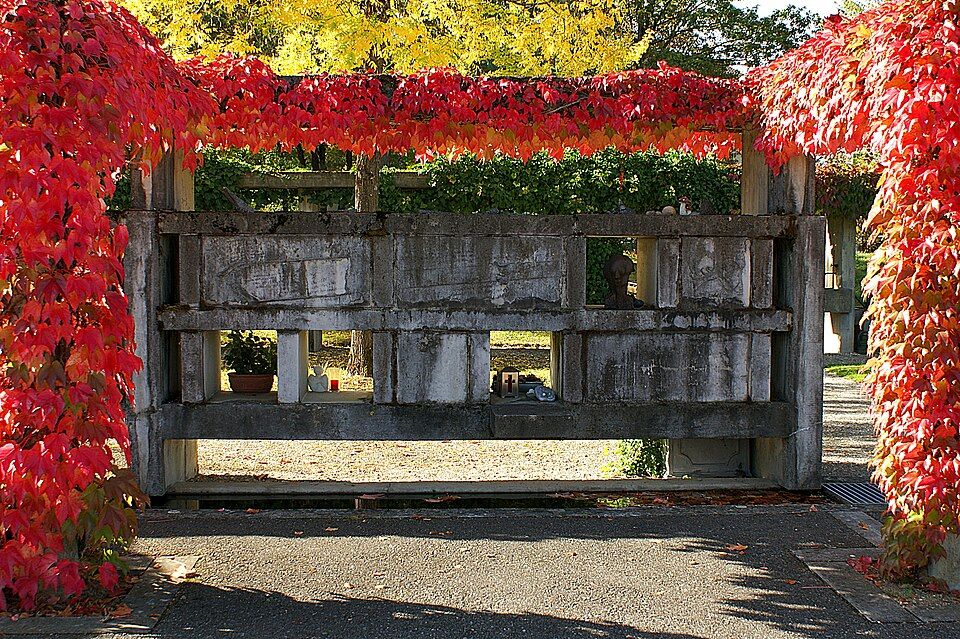
Urn niche wall

- Artist
- Schang Hutter
- Year
- 1994
- Material
- Cement, cast iron
- Location
- Bümpliz Cemetery, Bottigenstrasse 40
History of the work
The western part of the Bümpliz cemetery, opened in 1994, contains three urn walls laid out like a fan. Their niches and slabs are populated with reliefs and figures by the Solothurn sculptor Schang Hutter; the city's register gives cement and cast iron as materials. According to the City of Bern's brochure on the cemetery, they include cast-iron heads with two faces that refer to Janus, the Roman god of beginnings and endings. Some slabs also carry poems by Peter Bichsel and Friedrich Hölderlin and a verse from a medieval dance of death.
The extension has a long history. The large housing estates built in Bümpliz between 1958 and 1986 made the population grow sharply, and the cemetery needed more room. In 1987 the city held an ideas competition, won by the Bernese architects Ueli Schweizer and Walter Hunziker. Their design included a footbridge over Heimstrasse; since this would have required lowering the road, the project was revised and finally built without the bridge. Work began in 1992. According to Wikipedia the architects designed the complex together with the landscape architect Franz Vogel and with Hutter; a photo in the brochure shows Hutter and Schweizer inspecting the cast relief slabs on the building site.
According to the Historical Dictionary of Switzerland, Hutter (1934–2021) trained as a stone sculptor in his parents' workshop from 1950 to 1954, attended the school of applied arts in Bern and then studied in Munich until 1961. The dictionary counts him among the outstanding figurative sculptors of the country and describes his figures as puppet-like and vulnerable. He became known nationwide in 1998 through his iron sculpture 'Shoah': he set it up in front of the Federal Palace, a few days later the Swiss Freedom Party had it removed at night, and a heated public debate followed (Wikipedia).
Since the opening, nature has visibly changed the site. According to the brochure, moss and lichen now grow on the once smooth concrete parts, and the reliefs too show signs of weathering. Some inscriptions are therefore hard to read; the brochure suggests tracing the letters with a finger.
Researched and summarised by Bärn Kit. Sources: Kultur Stadt Bern, Kunst im öffentlichen Raum (offene Daten) · Stadt Bern: Broschüre Friedhof Bümpliz (2018) · Wikipedia (de): Friedhof Bümpliz · Wikipedia (de): Schang Hutter · HLS: Schang Hutter · SIKART: Schang Hutter · Wikimedia Commons: Reliefs und Statuen in Urnenwänden (Schang Hutter 1994)
Nearby
Grave of Thea Ketterer60 mTrans-lating (Über-setzen)100 mCrouching female figure140 mUntitled140 mCommunal grave210 mMore by Schang Hutter
Vulnerability1999Add a photo
Been there? Send us your own photo of “Urn niche wall”. It is made smaller on your phone and loses its GPS data in the process. We check every photo by hand and show it with your name and the date.
Data: Kultur Stadt Bern (open data “Kunst im öffentlichen Raum”). Found a mistake? Write to hallo@uebrig.ch.