Cenotaph
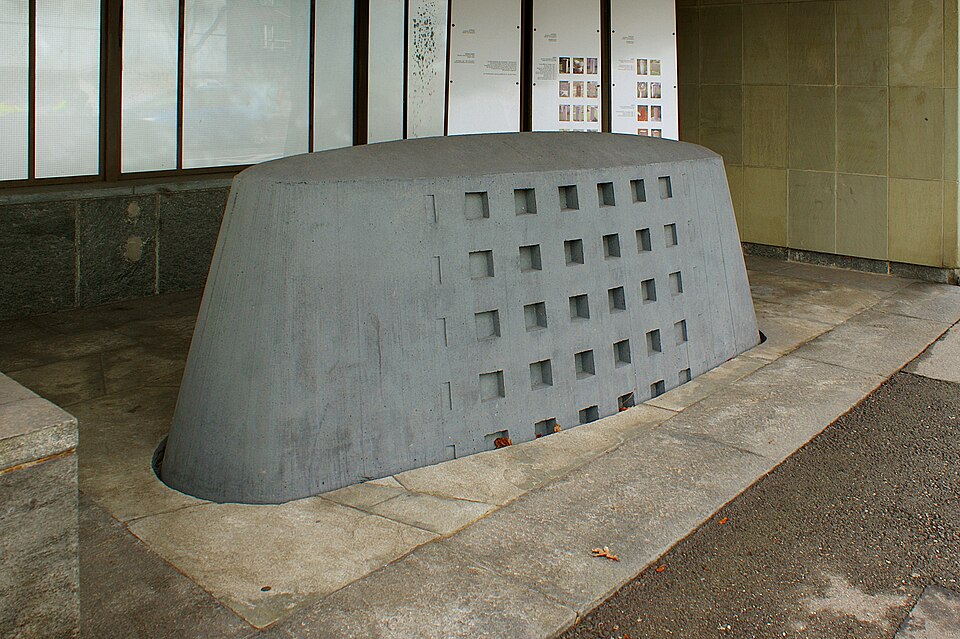

- Artist
- Walter Kretz
- Year
- 2002
- Material
- Concrete mixed from black sand and black gravel, iron
- Location
- Bremgarten Cemetery, Murtenstrasse 51, main entrance
About the work
Im Wartehäuschen der ehemaligen Bushaltestelle steht das Werk Kenotaph von Walter Kretz. Es verweist auf den dahinterliegenden Bremgartenfriedhof. Ein Kenotaph ist ein Scheingrab, in dem keine sterbliche Überreste bestattet sind und das als Gedenkstätte dient.
Walter Kretz wählte für sein Kenotaph eine schlichte Form. Sie ähnelt einem halb im Boden versunkenen und im Massstab verkleinerten Gebäude, welches sich in die Bauten an der Murtenstrasse einreiht. Gleichzeitig erinnern die Formgebung und das gewählte Material an einen Sarkophag. Dahinter stehen drei symbolische Tragbahren aus Eisen. Sie wurden zu Anschlagbrettern umfunktioniert, auf denen bis vor einiger Zeit die von der Grabmalkommission ausgezeichneten Grabstätten präsentiert wurden.
Text: Ba Berger, 2022 (Original text in German). Source: Kultur Stadt Bern (open data “Kunst im öffentlichen Raum”).
History of the work
In front of the main entrance of the Bremgarten cemetery, inside a former public transport shelter that opens onto Murtenstrasse, stands an installation by Walter Kretz from 2002. Its title, 'Kenotaph' (cenotaph), means an empty grave: a memorial to the dead whose remains do not lie there. The block is made of concrete mixed with black sand and black gravel, together with parts in iron. Wikimedia Commons describes the work as a memorial to the last journey.
According to the description by Kultur Stadt Bern, the plain shape looks like a scaled-down house half sunk into the ground, so that it fits into the row of buildings along Murtenstrasse; at the same time its form and material recall a sarcophagus. Behind the block stand three iron stretchers. According to the same source they were converted into notice boards, on which for a time the graves awarded a prize by the grave monument commission were presented.
Kretz was born in Steckborn on 18 December 1942 (SIKART). According to Wikipedia, after a visit to the sculptor Gustave Piguet he abandoned his path to the school-leaving exam and trained as a stone sculptor with Hans Brogni in Nidau. He has lived in Bern since 1958. His known works include the concrete relief at the Schanzenpost from 1971 and the 'Flügel' (Wing) in the Wittigkofen district from 1983, which local children call the 'elephant ear'. According to SIKART he taught at the schools of design in Bern and Biel from 1975 to 2008 and lectured at the Bern University of the Arts from 1999 to 2008.
He was also linked to the cemetery through his work as an expert on grave monuments for the Bern cemetery administration; in 2001 he launched a research project on the design of grave markers at the University of the Arts (Wikipedia). The cemetery behind the shelter opened at the end of 1864 and, at around 16 hectares, is the second largest in the city. Walking on from here, you will find a second work by Kretz in field H4, the memorial stone at the anatomy grave.
Researched and summarised by Bärn Kit. Sources: Kultur Stadt Bern, Kunst im öffentlichen Raum (offene Daten) · Wikimedia Commons: Kategorie Installation Kenotaph (Walter Kretz 2002) · SIKART: Walter Kretz · Wikipedia (de): Walter Kretz · Wikipedia (de): Bremgartenfriedhof · Stadt Bern: Broschüre Bremgartenfriedhof (2023)
Nearby
Untitled30 mBeing and Becoming100 mCrucifixion of Christ / Entombment of Christ / Resurrection of Christ / Christ with Angels110 mThe four zodiac signs of the four seasons or ages of life110 mTomb of Heinz Jost110 mMore by Walter Kretz
Worm1974-1977Communal grave1975Shrine1979Various portrait heads1979Add a photo
Been there? Send us your own photo of “Cenotaph”. It is made smaller on your phone and loses its GPS data in the process. We check every photo by hand and show it with your name and the date.
Data: Kultur Stadt Bern (open data “Kunst im öffentlichen Raum”). Found a mistake? Write to hallo@uebrig.ch.