Bear Pit (Bärengraben)
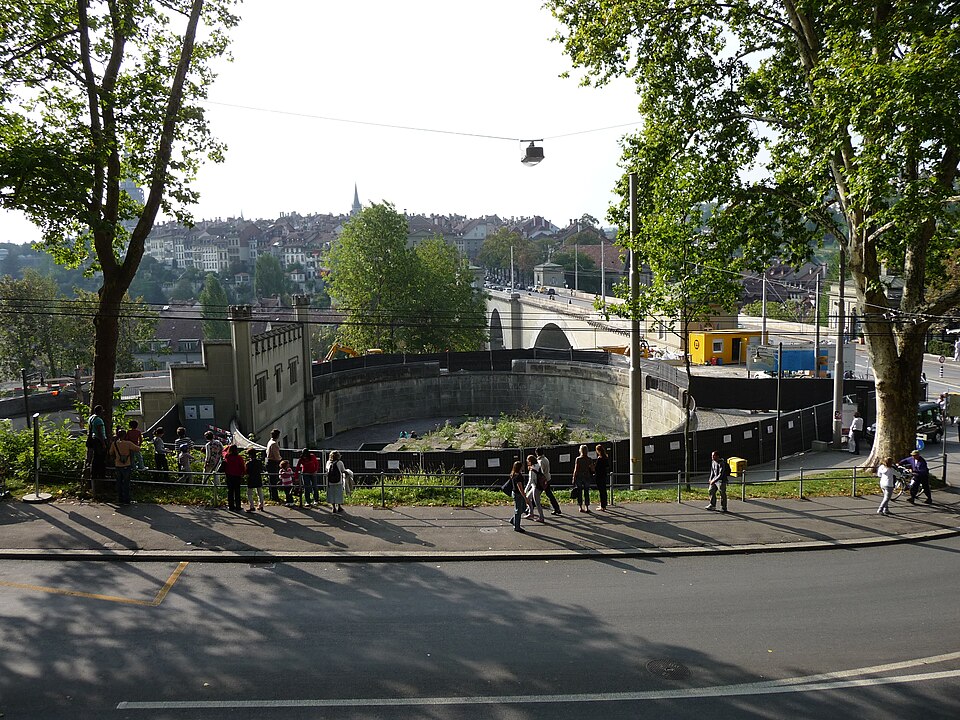
The Bear Pit on Grosser Muristalden in Bern was built in 1856/57 and since 2009 has been part of the Bear Park on the Aare bank opposite the old town.

Visiting
- Getting there
- Bus 12 to the stop “Bärenpark”.
- Open
- Every day, around the clock.
- Admission
- Free, including the BäreBähnli.
- Access
- The BäreBähnli (inclined lift) links the upper platform step-free with the path along the Aare.
- Tip
- In late autumn the bears retreat into their winter rest and are seen less often.
Checked 24 October 2026. Sources: Tierpark Bern – BärenPark
- Address
- Grosser Muristalden 4
- Built
- 1856–1857; Bear Park 2009
- Architect
- Friedrich Tschiffeli (master builder); Bear Park: Matti Ragaz Hitz Architekten
- Style
- Historicism, neo-Gothic keeper's house
- Today
- Part of the Bear Park of the Bern zoo
- Protection
- cultural property of national significance (KGS A), worthy of protection (Bauinventar)
About the building
At the eastern end of the Nydegg Bridge, opposite the old town, lie two large oval pits, separated by a wall. On their north side stands a small neo-Gothic bear castle: two slender polygonal turrets with battlements frame a show facade with windows and a crenellated crest. Behind this facade there is only a modest lean-to building, originally the keeper's house.
Bears have belonged to Bern for centuries; the bear is its heraldic animal. When the first bear pit was created is given differently by the sources: Wikipedia cites a first record from 1441 near the Käfigturm, while the Bern zoo tells of a bear that Bernese troops brought back from the Battle of Novara in 1513 and of a first pit on today's Bärenplatz from 1515. Later the pits lay near the Bollwerk. The present one is the fourth; it was built in 1856/57 by the master builder Friedrich Tschiffeli for the city of Bern and opened in 1857. As a historicist enclosure, it goes back to the old tradition of keeping bears in defensive ditches.
Later a smaller pit in the shape of a circle segment was added for young bears, in 1924 according to the building inventory, in 1925 according to Wikipedia. In 1974 the keeper's house was shortened to make room for a passage and a shelter. Because animal welfare groups repeatedly criticised the conditions, climbing hills and caves of large sandstone blocks were built into the pits in 1995 to plans by Andreas Furrer. The Bear Park by Matti Ragaz Hitz Architekten with Klötzli + Friedli landscape architects followed in 2009: an open enclosure of more than 6000 square metres on the Aare slope, opened on 22 October 2009. According to Wikipedia it cost about 24 million francs, far above the first budget.
The large pit is linked to the park by a tunnel and is still used for the bears, for example when the enclosure is being cleaned. The small pit is now open to the public. The buildings of the Bear Pit are a cultural property of national importance.
A detail to look for: the battlements on the turrets, which give the keeper's house the look of a small castle.
Researched and summarised by Bärn Kit. Sources: Bauinventar der Stadt Bern: Grosser Muristalden 4 · Tierpark Bern: Bern and its bears · Wikipedia (de): Bärenpark Bern · Wikidata: Q666040
Buildings nearby
Former public toilet at Grosser Muristalden 350 mFormer tram depot at Grosser Muristalden 650 mFormer tram shelter at Grosser Muristalden 1A50 mMuristalden Fountain60 mNydeggbrücke (Nydegg Bridge)70 mClimbing rockArtwork · 10 mBearsArtwork · 10 mDonation BearArtwork · 20 mMore sights in Bern
Rosengarten BernParks and bearsBärenPark Bern: the bears go into winter restParks and bearsElfenau Manor HouseParks and bearsClassification and address: Bauinventar © Amt für Kultur des Kantons Bern · Object sheet (PDF, German) · Wikidata. Found a mistake? Write to hallo@uebrig.ch.