Nydeggbrücke (Nydegg Bridge)
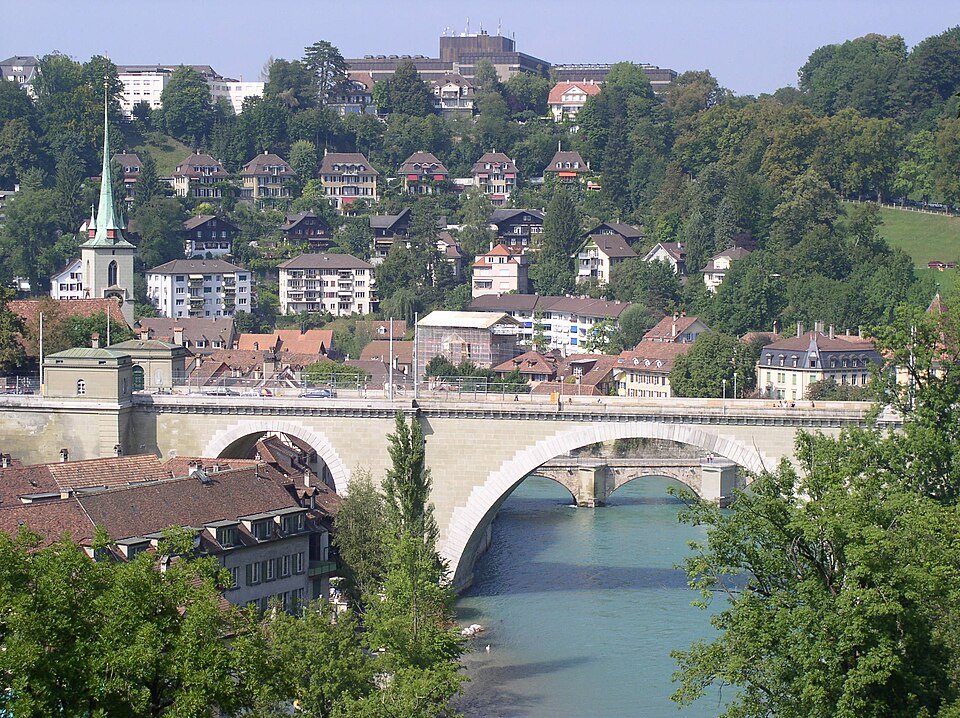
Since 1844 the Nydegg Bridge has linked Bern's lower old town with the Bärengraben; its stone arch over the Aare spans almost 46 metres.

- Built
- September 1840 to November 1844
- Today
- road bridge, cultural property of national significance
- Builder
- Karl Emanuel Müller (contractor); plans by Joseph Ferry, revised by Rudolf von Wurstemberger
- Length
- about 200 m (German Wikipedia) or 190 m (English Wikipedia, Wikidata); main arch almost 46 m
- Protection
- cultural property of national significance (KGS A)
About the building
The Nydegg Bridge leads from the Nydegg Church at the end of the old town across to the other bank of the Aare by the Bärengraben, the old bear pit. A large natural-stone arch of almost 46 metres spans the river, accompanied by two side arches of 16.5 metres each. Next to it, much lower down by the water, lies the far older Untertorbrücke. At the ends of the central section stand small pavilions that were intended as toll houses.
With growing goods and passenger traffic in the early nineteenth century, Bern wanted a high-level bridge so that carts no longer had to go steeply down into the Aare gorge and up again. There was a fierce dispute over the location; in the end the lower old town at the Nydegg won. In 1836 the Burgergemeinde obtained reports from four foreign bridge experts, among them Alois Negrelli, and then had the architect Joseph Ferry draw up plans. A bridge-building company changed them several times, and the project was still being adjusted during construction.
The bridge was built by the contractor Karl Emanuel Müller from Uri, who had studied architecture and bridge building in Vienna and had previously built the carriage road through the Schöllenen gorge. Work began in the autumn of 1840 and at first had to contend with floods. On 15 September 1843 the keystone of the main arch was set to the sound of cannon fire, and the ceremonial opening took place on 23 November 1844. Its core is of Jura limestone from near Solothurn, faced with sandstone from Ostermundigen. There are two figures for its total length: about 200 metres according to the German Wikipedia, 190 metres according to the English Wikipedia and Wikidata.
Financially the venture was not a success. The bridge tolls brought in far less than expected, and costs exceeded the budget. The problem was only solved when the tolls were abolished on 1 March 1853 and the shareholders received 70 per cent of their investment back; according to the English Wikipedia the canton then took over the bridge. From the start it was criticised for removing the gradients only in part. Today it is a cultural property of national significance. It is worth looking from the bank below: only from there can you see how high the main arch stands above the water.
Researched and summarised by Bärn Kit. Sources: Wikipedia (de): Nydeggbrücke · Wikipedia (en): Nydeggbrücke · Wikipedia (fr): Pont de Nydegg · Historisches Lexikon der Schweiz: Müller, Karl Emanuel (Urs Kälin) · Wikidata: Q458115
Buildings nearby
Former Klösterli Brewery at Klösterlistutz 2050 mFormer tram shelter at Grosser Muristalden 1A50 mStöckli of the former Klösterli inn (Klösterlistutz 18A)60 mBear Pit (Bärengraben)70 mFormer public toilet at Grosser Muristalden 370 mCamonetArtwork · 0 mDonation BearArtwork · 60 mBalancing BearArtwork · 60 mMore sights in Bern
UntertorbrückeBridges and viewsKirchenfeld BridgeBridges and viewsKornhaus BridgeBridges and viewsLorraine ViaductBridges and viewsAltenbergstegBridges and viewsClassification and address: Bauinventar © Amt für Kultur des Kantons Bern · Wikidata. Found a mistake? Write to hallo@uebrig.ch.