Elfenau Manor House
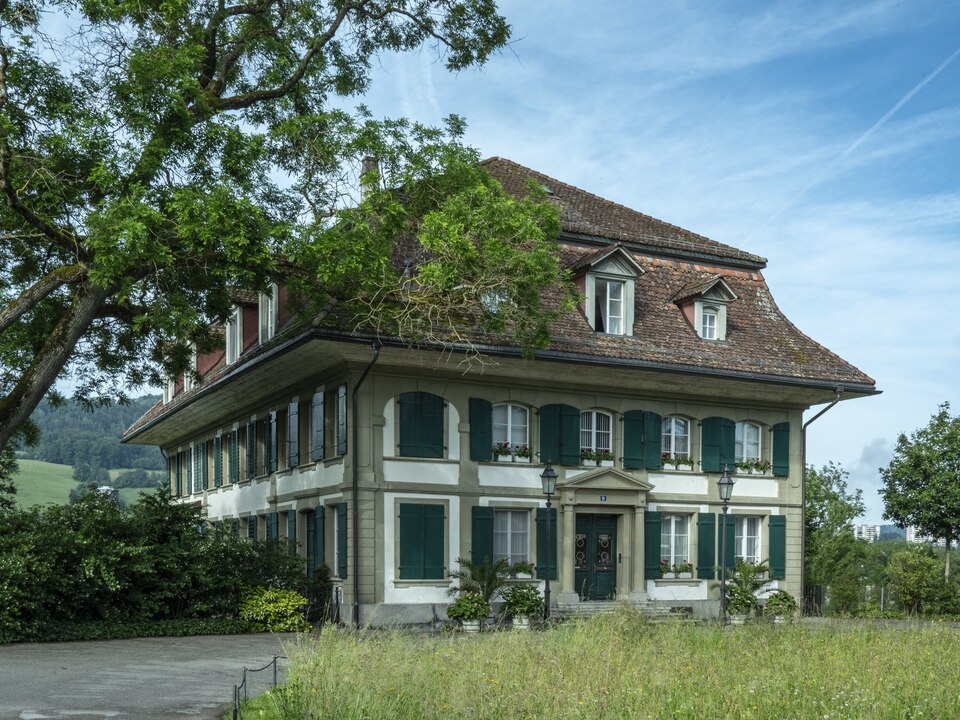
Elfenau manor house at Elfenauweg 91 in Bern is a country seat of about 1735/40, remodelled in Empire style from 1814 for Grand Duchess Anna Feodorovna.
Visiting
- Getting there
- Bus 19 to the terminus “Elfenau”.
- Open
- The park is public; the manor house and the side house are lived in and cannot be visited inside.
- Admission
- Park free.
- Tip
- In summer a café in the Kleine Orangerie, a playground and the nature reserve on the Aare.
Checked 24 October 2026. Sources: Stadt Bern – Elfenau · Stadt Bern – Elfenau Freizeitangebote
- Address
- Elfenauweg 91
- Built
- c. 1735–1740; remodelled 1814–1816 (inventory)
- Architect
- unknown; remodelling probably Osterrieth, Waeber or Schnyder
- Style
- Bernese country house, Empire remodelling
- Today
- Residential building in Elfenau Park
- Client
- Ludwig Vinzenz von Tscharner-von Bonstetten; remodelling for Anna Feodorovna
- Protection
- worthy of protection (Bauinventar)
About the building
On the edge of the terrace above the Aare, in Elfenau Park, stands a well-proportioned two-storey country house under a massive mansard roof. The entrance front has five bays and two-storey blind arcades reminiscent of an arcaded porch; in the centre is a portal with a triangular pediment dating from 1814. In front lies a forecourt with an Empire fountain of about 1820.
The building inventory dates the house to about 1735 to 1740; it replaced a 17th-century timber-framed house and was then called Brunnaderngut. The inventory explicitly rejects the frequently cited date of about 1775 and the attribution to Niklaus Sprüngli. Wikipedia, by contrast, mentions a country house of 1735 and at the same time says the old timber-framed house was demolished around 1780.
In 1814 Grand Duchess Anna Feodorovna (1781–1860) bought the estate. Born a princess of Saxe-Coburg-Saalfeld, she had settled in Bern in 1813 after her unhappy marriage to Grand Duke Constantine of Russia. She had the house remodelled in Empire style; the inventory names Johann Daniel Osterrieth, Karl Friedrich Waeber or Ludwig Friedrich Schnyder as the probable builders. On the garden side the base was turned into a garden hall. She is said to have chosen the name Elfenau (meadow of the elves) when the lawn was covered one morning with glittering dew; the council granted permission on 9 September 1816. Here she received relatives, among them her brother Leopold, later King of the Belgians, as well as diplomats and Bernese society. In 1838 she moved to Geneva.
In 1918 the City of Bern bought the estate. In 1928 the house was divided into three large apartments, and in 1940 an air-raid shelter was built into the garden hall; it was removed again in 2006 when the hall was restored. On the garden side facing the Aare, French windows open onto a balcony resting on cast-iron columns with a wrought-iron railing.
Researched and summarised by Bärn Kit. Sources: Bauinventar der Stadt Bern: Elfenauweg 91 · Bauinventar der Stadt Bern: Baugruppe Elfenau · Historisches Lexikon der Schweiz: Anna Feodorowna (Lucienne Hubler) · Wikipedia (de): Elfenau · Wikidata: Q113884510
Buildings nearby
Small Orangery and Tenant's House, Elfenau50 mElfenau Barn (Great Orangery)70 mFormer infant and mother home in the Elfenau270 mVilla at Luternauweg 12310 mVilla at Brunnadernrain 31350 mWater-Spouting MermaidArtwork · 40 mDolphin Fountain (Delphinbrunnen)Artwork · 40 mGirl figureArtwork · 90 mMore sights in Bern
Rosengarten BernParks and bearsBear Pit (Bärengraben)Parks and bearsBärenPark Bern: the bears go into winter restParks and bearsClassification and address: Bauinventar © Amt für Kultur des Kantons Bern · Object sheet (PDF, German) · Wikidata. Found a mistake? Write to hallo@uebrig.ch.