Burgerhaus on Amthausgasse
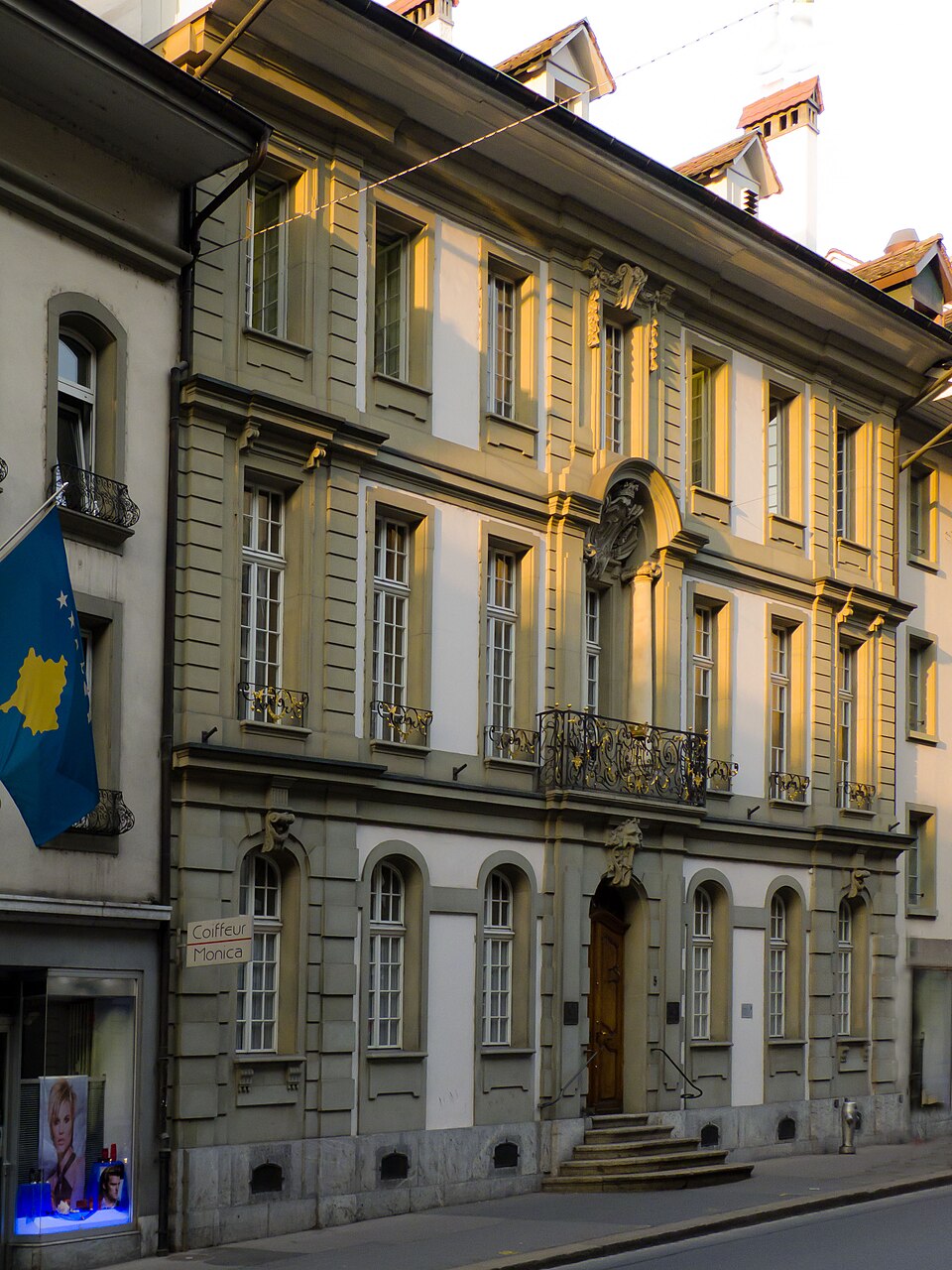
The Burgerhaus at Amthausgasse 5 is a town palace built around 1763 to 1765, with the only open garden left in Bern's upper Old Town.

- Address
- Amthausgasse 5
- Built
- around 1763–1765
- Architect
- Niklaus Sprüngli (per GSK); building inventory: Sprüngli or Erasmus Ritter, attributed
- Style
- late baroque town palace without arcades
- Today
- cultural property of national importance; seat of the Burgergemeinde administration from 1949
- Protection
- cultural property of national significance (KGS A), worthy of protection (Bauinventar)
About the building
On Amthausgasse this house lacks what almost every Old Town facade in Bern has: arcades. The front of seven window bays is dominated by a strongly projecting central section, flanked by two side projections. The central projection holds a deep niche with a finely wrought balcony railing above it, and the main window carries a cartouche for a coat of arms. Sandstone framing is set against rendered wall surfaces. In 18th-century Bern this combination was frowned upon and hardly appeared except on the Stift building and the orphanage.
The house was built around 1763 to 1765 as an entirely new building for Johann Rudolf Fischer, named Fischer-Sellon (1733–1806) by Wikipedia. According to the art guide of the Society for the History of Swiss Art, its core still contains parts of a predecessor from 1625 to 1635. Who designed it is not fully certain: the art guide names Niklaus Sprüngli, while the city's building inventory attributes it to Sprüngli or Erasmus Ritter and notes that the monograph on Sprüngli does not count it among his secured works. The niche motif comes from Turin, Austria and France and is rare in Bern.
From 1836 the house belonged to the Marcuard family, which is why it is also called the Marcuard-Haus. In 1949 the Burgergemeinde Bern, the city's corporation of old citizen families, bought it and made it the seat of its administration. The architects Zeerleder & Wildbolz restored it from 1950 to 1952 and added a new south wing; the facade was renewed in 1973.
Towards Kochergasse a railing with a gate closes off the garden, which has survived as the only open garden in the upper Old Town. The three-storey garden front projects on three sides at its centre. Inside, the flights of a monumental staircase wind around an open well resting on four piers; figures of putti and lions crown the balustrades. Stone carving, stucco, panelling, parquet, metalwork and stoves shape the rooms, which were fitted out between 1765 and 1785. The Burgerhaus is a cultural property of national importance.
Researched and summarised by Bärn Kit. Sources: Bauinventar der Stadt Bern: Amthausgasse 5 · KGS-Inventar, Objektbeschreibung GSK-Kunstführer: Burgerhaus (KGS 616) · Wikipedia (de): Amthausgasse (Bern) · Wikidata: Q19362472
Buildings nearby
Guild House zu Mittellöwen40 mHotel Bellevue Palace50 mHauptwache (main guardhouse)70 mThe so-called Kaiserhaus90 mSwiss National Bank building110 mMarksman Fountain (Schützenbrunnen)Artwork · 80 mHeadlessArtwork · 100 mSaint ChristopherArtwork · 120 mClassification and address: Bauinventar © Amt für Kultur des Kantons Bern · Object sheet (PDF, German) · Wikidata. Found a mistake? Write to hallo@uebrig.ch.