French Church (Französische Kirche)
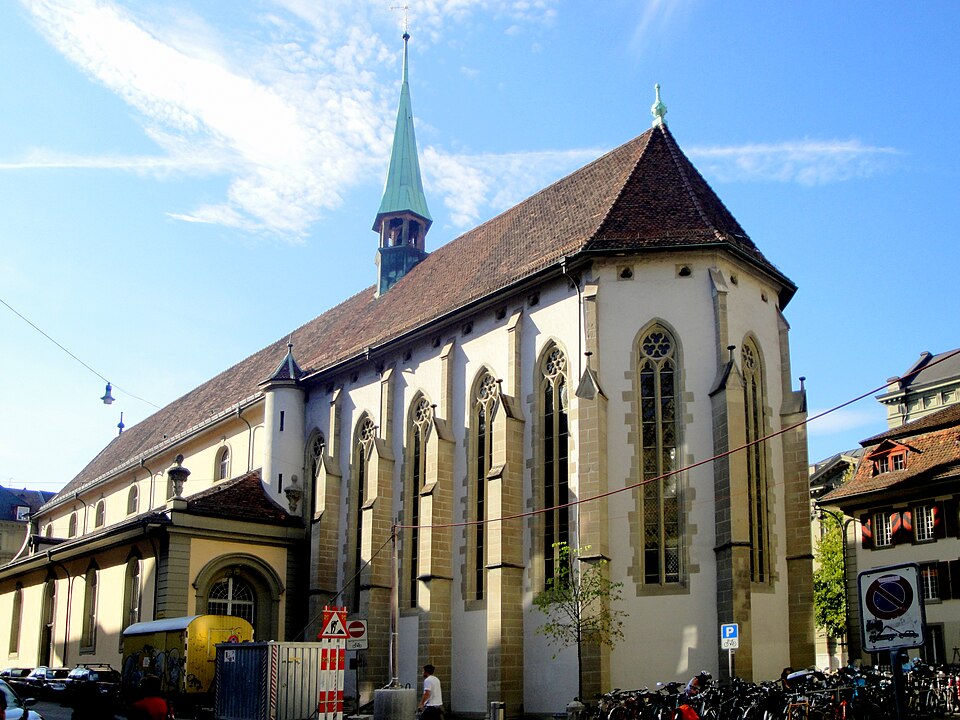
The French Church on Zeughausgasse is the former Dominican church of the late 13th century and the oldest surviving church building in Bern.

- Address
- Predigergasse 3, Zeughausgasse 8
- Built
- Late 13th century (building inventory: 1270–1285)
- Architect
- Dominican order; alterations by Abraham Wild (18th century) and Karl Indermühle (choir)
- Style
- 13th-century Dominican church, baroque west front
- Today
- Church of the French-speaking Reformed parish, concert venue
- Protection
- cultural property of national significance (KGS A), worth preserving (Bauinventar)
About the building
Between Zeughausgasse and Predigergasse stands a long, plain building with a high roof. According to the city's building inventory it is the oldest surviving religious building in Bern. It was built by the Dominicans, who had been in Bern since 1269; they were also called preachers, hence the old name Predigerkirche. Construction falls in the years after 1270; the inventory gives 1270 to 1285. At that time the friary still lay outside the city walls. The church was dedicated to Saints Peter and Paul.
The rood screen, the barrier between choir and nave, was built together with the church. In 1495 it was decorated with paintings from the circle of the Bernese Carnation Masters. After the Reformation the friary was dissolved and in 1534 the choir became a granary; a wall on top of the rood screen separated it from the nave, and an organ was placed on the screen's gallery. Before 1520 Niklaus Manuel painted his famous Dance of Death on the wall of the churchyard. The paintings were lost when the wall was pulled down in 1660.
The present name comes from the congregation that worships here. According to Wikipedia, services were held in French from 1623; after the revocation of the Edict of Nantes in 1685 the church became the centre of the Huguenots who had fled to Bern. The building inventory gives 1685 as the year the church was handed over to the refugees' congregation. In the 18th century Abraham Wild rebuilt the south aisle and the west front; Wikipedia dates the baroque west front to 1753. From 1849 to 1864 the empty choir housed the collections of the Bernese Art Society and of the state, a forerunner of the Kunstmuseum.
Karl Indermühle restored the choir, from 1909 to 1912 according to Wikipedia, in 1912/13 according to the building inventory; a neo-baroque sacristy was added on the north side. In 1963/64 most of his fittings were removed, and in 1967–1969 the choir regained its windows from before 1912. Between choir and nave a cross passage links the two spaces. Today the church serves the French-speaking Reformed parish and is a popular venue for choral concerts. The organ was built by the Goll firm in 1991 inside a historic case made by Franz Josef Remigius Bossart in 1828; it has 66 stops. The church has been under cantonal protection since 1908.
Researched and summarised by Bärn Kit. Sources: Bauinventar der Stadt Bern: Zeughausgasse 8 (früher Predigergasse 1) · Bauinventar der Stadt Bern: Predigergasse 3 / Nägeligasse 1A (Nachbarbau) · Historisches Lexikon der Schweiz: Indermühle, Karl · Wikipedia (de): Französische Kirche (Bern) · Wikidata: Q1450580
Buildings nearby
Rathaus zum Äusseren Stand60 mVolkshaus Bern60 mStadttheater Bern80 mFormer Kornhaus (Granary)100 mCorner house at Waisenhausplatz 21140 mThe People's Source of StrengthArtwork · 50 mMusicArtwork · 100 mThe DanceArtwork · 100 mMore sights in Bern
Church of the Holy Ghost (Heiliggeistkirche)ChurchesNydegg Church (Nydeggkirche)ChurchesFormer Antonier Church on PostgasseChurchesClassification and address: Bauinventar © Amt für Kultur des Kantons Bern · Object sheet (PDF, German) · Object sheet (PDF, German) · Wikidata. Found a mistake? Write to hallo@uebrig.ch.