Rathaus zum Äusseren Stand
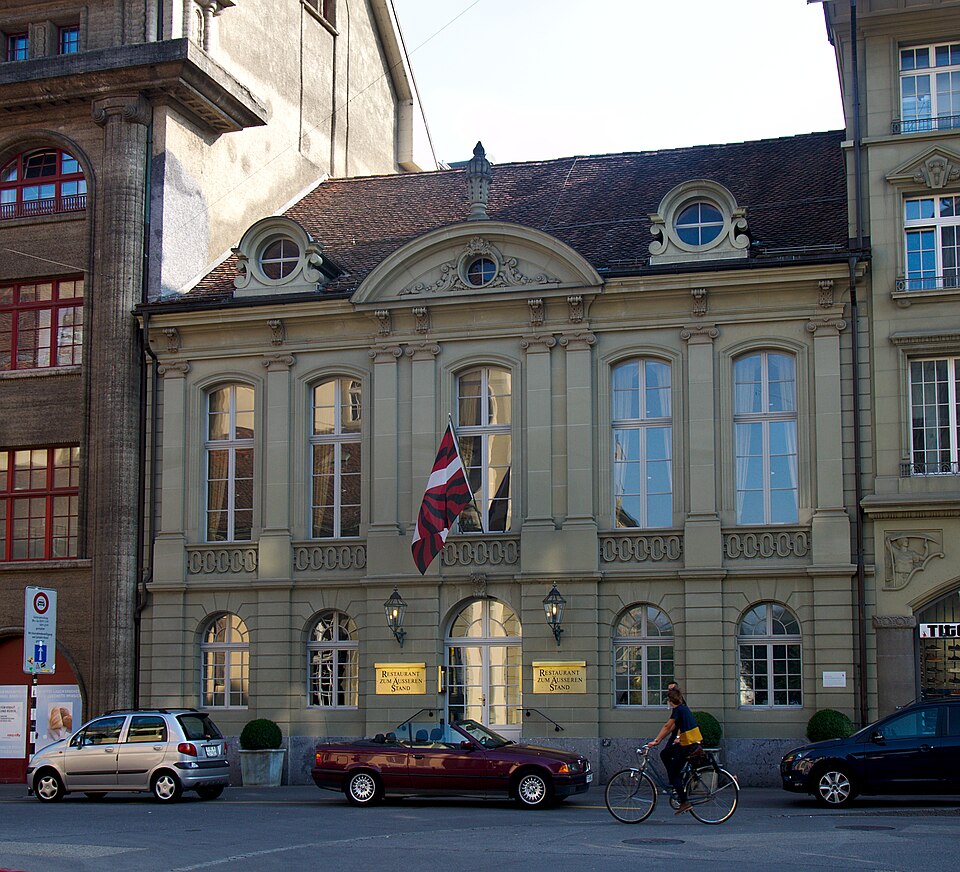
The Rathaus zum Äusseren Stand at Zeughausgasse 17 was built around 1730; in its Empire hall the Diet adopted the federal constitution in 1848.

- Address
- Zeughausgasse 17
- Built
- 1728–1730 (building inventory); 1728 (HLS); before 1731 (Wikipedia)
- Architect
- Albrecht Stürler (attributed)
- Style
- Baroque; hall in Empire style (1816/17)
- Today
- Rathaus des Äusseren Standes foundation; hall used for events
- Client
- Äusserer Stand
- Protection
- cultural property of national significance (KGS A), worthy of protection (Bauinventar)
About the building
At Zeughausgasse 17 stands a baroque building that the city's heritage office counts among the most important works of Bernese architecture from the second quarter of the eighteenth century. According to the building inventory it was built from 1728 to 1730, and the plans are attributed to Albrecht Stürler. The Historical Dictionary of Switzerland gives 1728 as the year of construction, while Wikipedia speaks of a building erected before 1731.
It was built for the Äusserer Stand, a society of young citizens of Bern documented as an institution with its own statutes from 1556. It imitated the offices of the city government, from the mayor through the councils to the bailiffs, and in the seventeenth and eighteenth centuries it was regarded as a training ground for future members of the ruling class. The highlights of the year were the filling of offices and a procession on Easter Monday. With the end of the old republic of Bern in 1798 the society disappeared.
The house remained a political place. In 1799 the Senate of the Helvetic Republic met here, from 1804 to 1847 the Diet, which adopted the first federal constitution in the hall in 1848, and from 1848 to 1858 the Council of States. The great hall on the first floor had been remodelled in the Empire style by Carl Ahasver von Sinner in 1816/17. In this hall the first Bernese cantonal constitution was drawn up in 1831, and in 1874 the Universal Postal Union was founded here. Later, until 1934, the Swiss Alpine Museum was housed in the building.
In 1904 the building passed into private hands. The ground floor was given two wide shop openings, later even the hall served as a salesroom, and in 1942 the staircase was destroyed. In 1979 the Confederation, the canton, the city, the Burgergemeinde, the Post and private donors set up a foundation that bought the house and had it thoroughly restored, from 1980 to 1982 according to the foundation and from 1981 to 1984 according to the building inventory. The facade also regained its original appearance. In 1995 the Federal Council presented the revised federal constitution here. The Empire hall, used for events today, is considered one of the most important historic interiors in the city.
Researched and summarised by Bärn Kit. Sources: Bauinventar der Stadt Bern: Zeughausgasse 17 · Historisches Lexikon der Schweiz: Äusserer Stand (André Holenstein) · Stiftung Rathaus des Äusseren Standes: Website · Wikipedia (de): Rathaus zum Äusseren Stand · Wikidata: Q2132645
Buildings nearby
Volkshaus Bern20 mFrench Church (Französische Kirche)60 mFormer Kornhaus (Granary)100 mPatrician house at Kornhausplatz 2110 mStadttheater Bern120 mThe People's Source of StrengthArtwork · 30 mMarksman Fountain (Schützenbrunnen)Artwork · 90 mHistorical friezeArtwork · 100 mMore sights in Bern
ZytgloggeOld town and landmarksBern MinsterOld town and landmarksFederal Palace (Bundeshaus)Old town and landmarksKäfigturmOld town and landmarksErlacherhofOld town and landmarksFormer Kornhaus (Granary)Old town and landmarksClassification and address: Bauinventar © Amt für Kultur des Kantons Bern · Object sheet (PDF, German) · Wikidata. Found a mistake? Write to hallo@uebrig.ch.