Guildhall zu Pfistern
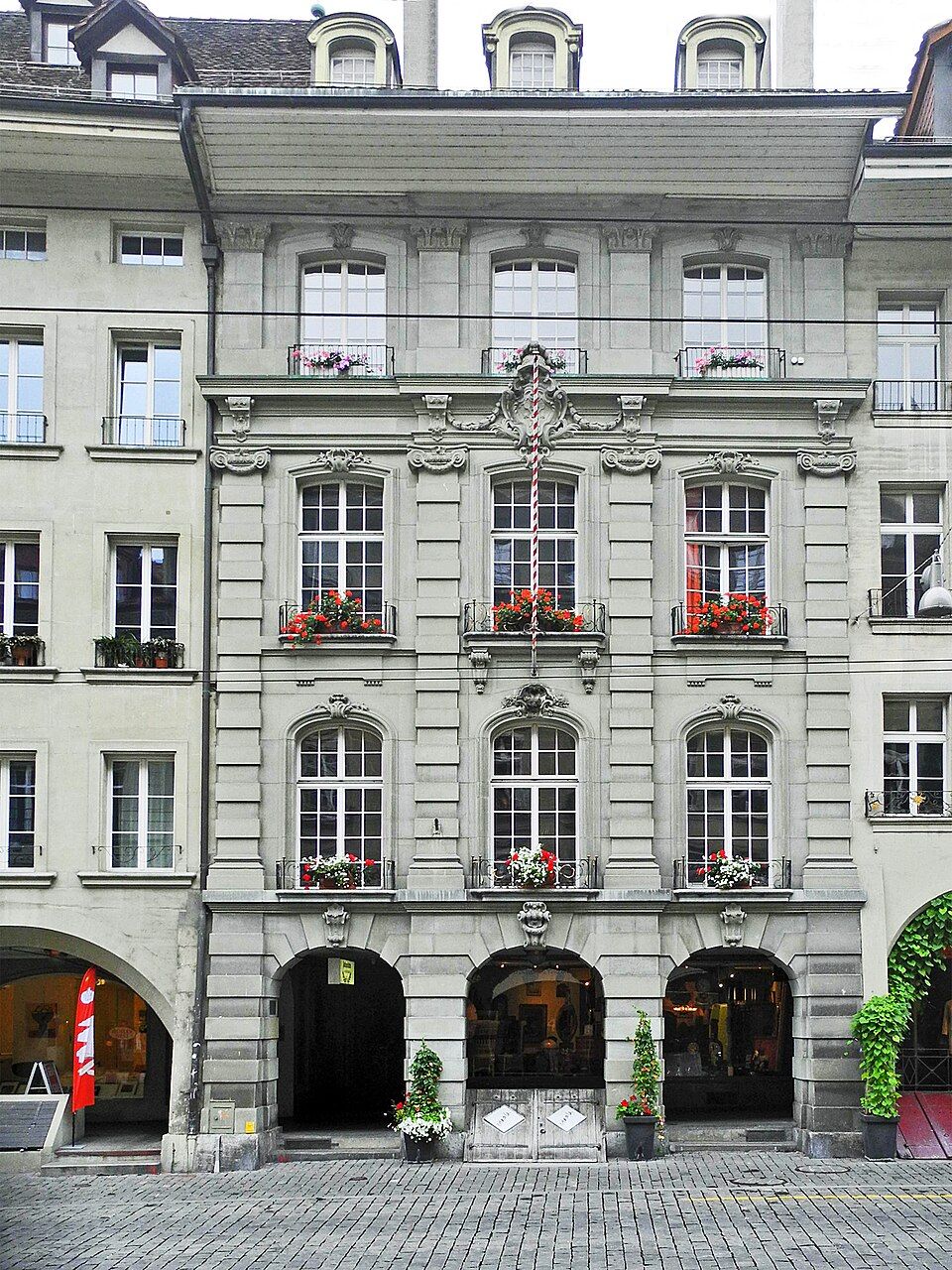
The Pfistern guildhall at Kramgasse 9 in Bern was built in 1769–70 as a town house; since 1926 it has been the guildhall of the bakers and millers.

- Address
- Kramgasse 9, Münstergasse 8
- Built
- 1769–1770; guildhall since 1926
- Architect
- probably Rudolf August Ernst, after a modified design by Niklaus Sprüngli
- Today
- Guildhall of the Gesellschaft zu Pfistern, cultural property of national significance
- Protection
- cultural property of national significance (KGS A), worthy of protection (Bauinventar)
About the building
Under the arcades of Kramgasse, number 9 catches the eye with its lively articulated sandstone front. Since 1926 it has been the seat of the Gesellschaft zu Pfistern, the old guild of bakers and millers. It was not built for them, however, but as the residence of a patrician.
The client in 1769–70 was Johann Ludwig Stürler. The plans go back to a design by Niklaus Sprüngli, which was probably carried out in modified form by Rudolf August Ernst. Above the banded arcade storey, a giant order unites the two main floors. Three bays, framed by banded Ionic pilasters, articulate the front; the middle one projects. The third upper floor sits as an attic on a strong cornice with a cartouche at its centre.
The coat-of-arms relief with the helmet on the facade was added only in 1926, when the society moved in. Look out for it: it is the visible sign of the change of ownership. Behind the house is a large courtyard with a gallery of four basket arches, containing a semi-oval staircase with sweeping railings. The art guide describes the interiors, with wood panelling and Louis XV fireplaces, as excellent.
The society itself is much older than the house. It appears in the sources in the 14th century, according to its own information first in 1314, and united the city's bakers and millers; the name comes from the Latin “pistor”, baker. From the 15th century one of the city's four Venner had to belong to the Gesellschaft zu Pfistern. Many of the families that later formed the Bernese patriciate were members here.
Before moving to Kramgasse the society owned another house. For a new building of 1849 to 1851, the Historical Dictionary of Switzerland names the architect Friedrich Studer, who later built the Federal Council building. Today the society is a corporation of the Burgergemeinde and rents out its guild hall for events.
Researched and summarised by Bärn Kit. Sources: KGS-Inventar (Text GSK-Kunstführer): Gesellschaftshaus zu Pfistern, KGS 11620 (Archivkopie) · Wikipedia (de): Gesellschaft zu Pfistern · Gesellschaft zu Pfistern: Geschichte · Historisches Lexikon der Schweiz: Friedrich Studer · Bauinventar der Stadt Bern: Untere Altstadt, alle Adressen (nur Liste) · Wikidata: Q14563352
Buildings nearby
House at Kramgasse 710 mLower May House10 mDiesbachhaus on Münstergasse30 mKreuzgassbrunnen40 mBern Minster50 mLösch FountainArtwork · 70 mMain portal of Bern Minster / Last JudgementArtwork · 80 mBanneret Fountain (Vennerbrunnen)Artwork · 100 mClassification and address: Bauinventar © Amt für Kultur des Kantons Bern · Object sheet (PDF, German) · Wikidata. Found a mistake? Write to hallo@uebrig.ch.