Gymnasium Kirchenfeld
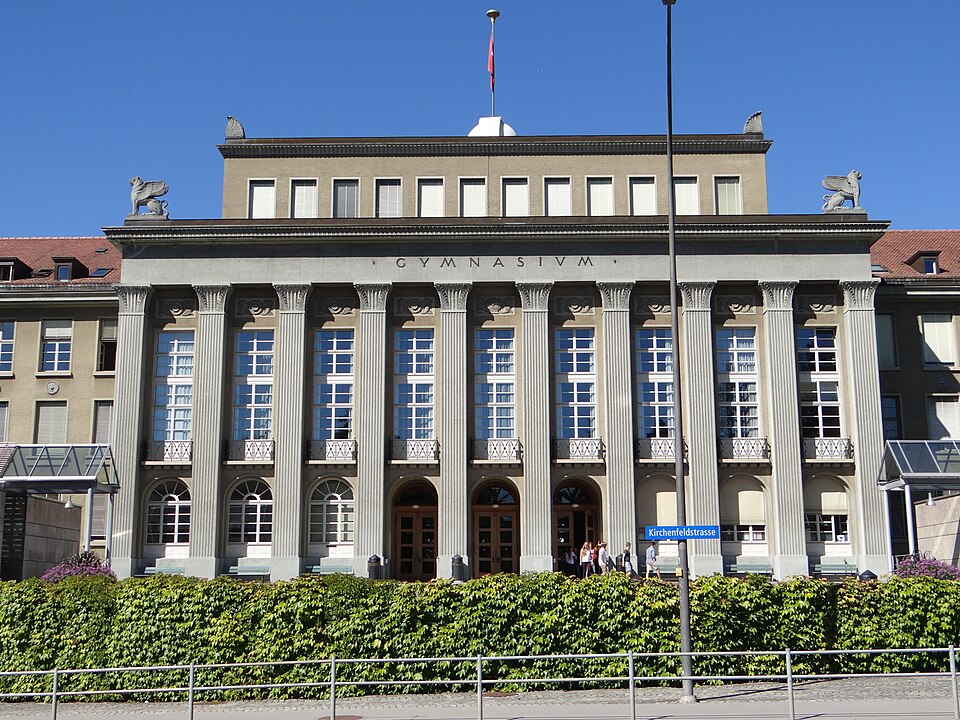
The Gymnasium Kirchenfeld at Kirchenfeldstrasse 25 is a strict, classically ordered school building of 1923–1926 with murals by Cuno Amiet.

- Address
- Kirchenfeldstrasse 25
- Built
- 1923–1926 (school founded 1834)
- Architect
- Widmer & Daxelhoffer
- Style
- Neoclassicism
- Today
- Cantonal upper secondary school with three departments
- Protection
- cultural property of regional significance (KGS B), worthy of protection (Bauinventar)
About the building
Along Kirchenfeldstrasse stretches a long, symmetrical block on a high base. In the middle a nine-bay section projects, articulated by fluted pilasters rising through several storeys; their capitals are decorated with palmettes. Winged lions sit at the corners of the entablature, with a recessed attic above. The side wings have twelve window bays each and are almost without ornament, apart from rosettes between the windows. Together with the National Library on Hallwylstrasse, built a few years later, the school frames a square where you can read the rapid change of style in the 1920s.
The school is older than its building. With the founding of the university in 1834 came the Literarschule, which was called the Kantonsschule from 1856 to 1880 and was then merged with the municipal Realschule to form the Städtisches Gymnasium. Until 1885 it was housed at Herrengasse 25, then on the Waisenhausplatz. In 1922 the city held a competition for a new building. It was built in 1923–1926 to plans by the firm of Widmer & Daxelhoffer, for the municipality of Bern. The school moved in in 1926.
The building is often seen as old-fashioned next to the modern National Library. Writing in the newspaper „Der Bund“ in 2024, the architectural historian Dieter Schnell called this a misunderstanding: after the First World War, he argues, architects looked to the plain architecture of the Biedermeier period and used classical forms to give a large school a clear order. That is why the assembly hall lies on the first floor directly above the main entrance, behind the central pilasters. A round fountain stands in its foyer. According to the building inventory, the building is preserved as it was built.
Inside there is art of the 1920s. In 1927/28 Cuno Amiet, with J. P. Flück, painted five large pictures of Bernese figures in the assembly hall, among them Jeremias Gotthelf, the surgeon Theodor Kocher and the painter Ferdinand Hodler, together with Philipp Emanuel von Fellenberg and Jakob Stämpfli. In 1928 Victor Surbek created murals of the wanderings and homecoming of Odysseus. In the playground stand bronze groups of boys and girls by Karl Geiser, himself a former pupil. Two pavilions were added on the southern forecourt in 1988. Since 2005 the three former gymnasiums in the building have been united in one school with three departments.
Researched and summarised by Bärn Kit. Sources: Bauinventar der Stadt Bern: Kirchenfeldstrasse 25 · Dieter Schnell: Ode an ein Berner Gebäude, Der Bund, 9. April 2024 (PDF beim BSA) · Wikipedia (de): Gymnasium Kirchenfeld · Wikipedia (fr): Gymnase de Kirchenfeld · Wikidata: Q1558147
Buildings nearby
Chapel of the Apostolic congregation at Helvetiastrasse 23100 mFederal Mint120 mMuseum of Communication120 mSemi-detached house at Hallwylstrasse 24/26140 mDouble villa at Aegertenstrasse 7/9140 mLarge Discus ThrowerArtwork · 40 mGroup of BoysArtwork · 50 mGroup of GirlsArtwork · 50 mClassification and address: Bauinventar © Amt für Kultur des Kantons Bern · Object sheet (PDF, German) · Wikidata. Found a mistake? Write to hallo@uebrig.ch.