Bruder Klaus Church
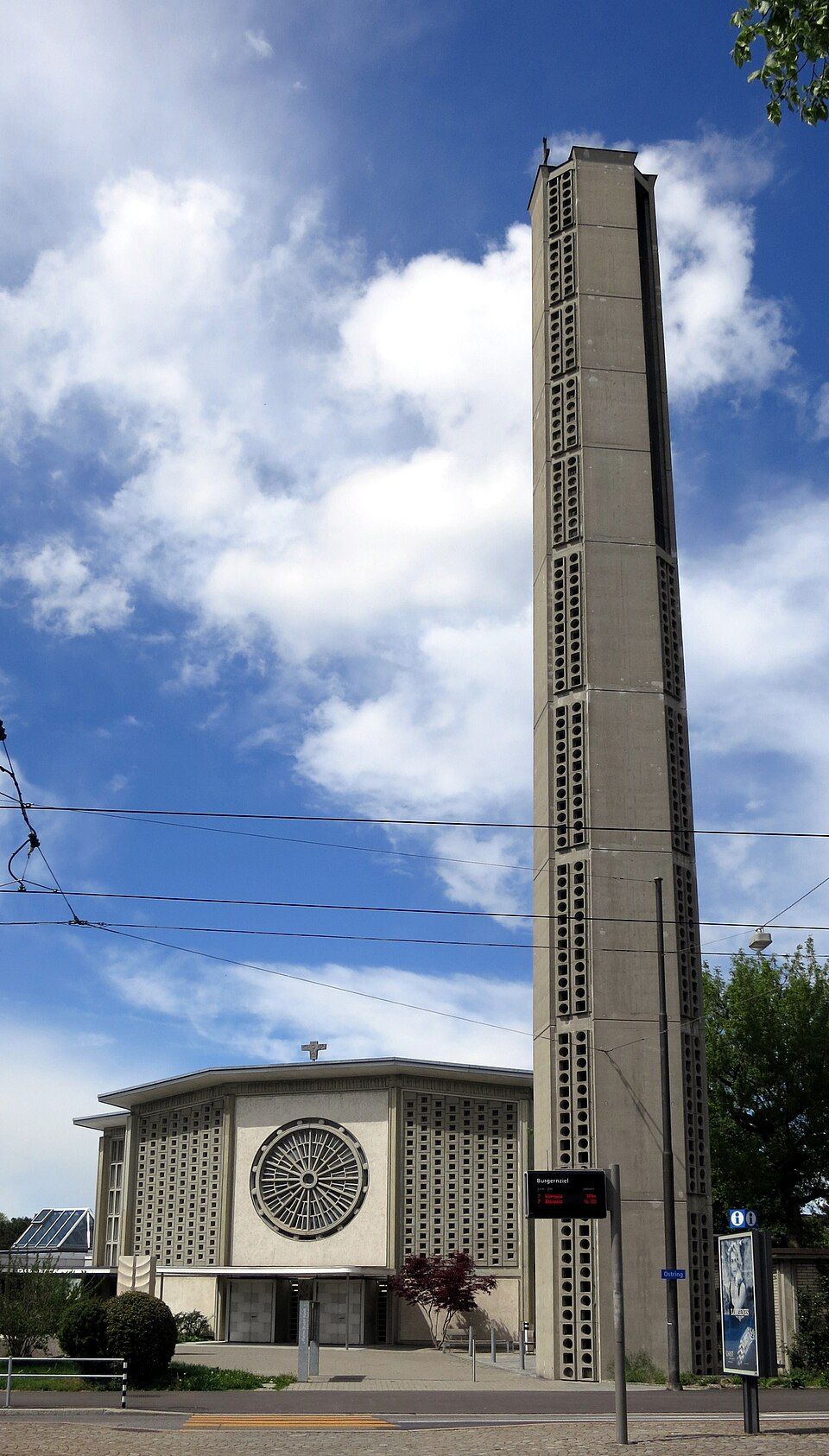
The Catholic Bruder Klaus Church at Ostring 1 near Burgernziel was built in 1953/54 to plans by Hermann Baur and is a milestone of modern church building.

- Address
- Ostring 1
- Built
- 1953–1954
- Architect
- Hermann Baur, Basel ("Hans Baur" in the Bauinventar); construction Walter Bitter
- Style
- Modern concrete church of the 1950s
- Today
- Roman Catholic parish church
- Protection
- cultural property of national significance (KGS A), worthy of protection (Bauinventar)
About the building
At the junction of Muristrasse, Ostring and Thunstrasse near Burgernziel, the tower catches the eye first: a polygonal campanile 35 metres high, free-standing right by the road and tapering towards the top. The church itself stands at an angle to it, set back from the street by a forecourt, and is aligned with the centre of the roundabout. Low annexes with a hall and the presbytery are grouped around the forecourt. Above the entrance is a large rose window of concrete and glass designed by Ferdinand Gehr.
The priest Josef Emil Nünlist had already bought the plot from the Burgergemeinde in 1938, because the city was growing strongly towards the east. In 1951 a jury chose the project by the Basel architect Hermann Baur; the Bauinventar gives his first name as "Hans", while Wikipedia, Wikidata and the architecture directory name him Hermann. The building was carried out by the Bernese architect Walter Bitter. The foundation stone was laid on 30 August 1953, and on 24 October 1954 Bishop Franziskus von Streng consecrated the church to Niklaus von Flüe, who had been canonised in 1947.
The church is a concrete frame building filled in with small concrete elements and sand-lime brick. The nave is short and unusually wide, aiming at a central space. Its walls are almost entirely dissolved into concrete lattices with blue-green glazing, similar to the translucent walls of a Gothic cathedral, while a high band of windows brightly lights the raised altar area. In this way Baur wanted to make the altar the centre of the space as well. A separate polygonal baptismal chapel follows the old model of the baptistery.
The complex was later extended: in 1986 a link building to the parish hall was added, and in 1989 the fountain "Quelle des Lebens" (Source of Life) by Karl Imfeld on the forecourt. The church is a cultural property of national importance. According to Wikipedia, after the Holy Trinity Church and St Mary's it is the third post-Reformation Catholic parish church in the city preserved in its original state.
Walking from the forecourt to the entrance, look up: in the rose window above the door, concrete meets coloured glass.
Researched and summarised by Bärn Kit. Sources: Bauinventar der Stadt Bern: Ostring 1, 1A–D, Segantinistrasse 24, 26, 26A · Wikipedia (de): Bruder Klaus (Bern) · Architekturbibliothek: Hermann Baur · Wikidata: Q19362499
Buildings nearby
Timber house at Muristrasse 3970 mApartment house at Muristrasse 33/35100 mVilla Jenner110 mApartment house at Muristrasse 31130 m“La Fadette” apartment house at Muristrasse 66150 mSource of LifeArtwork · 30 mFlying GeeseArtwork · 190 mRooster (Güggel)Artwork · 330 mClassification and address: Bauinventar © Amt für Kultur des Kantons Bern · Object sheet (PDF, German) · Wikidata. Found a mistake? Write to hallo@uebrig.ch.