Guildhall zu Kaufleuten
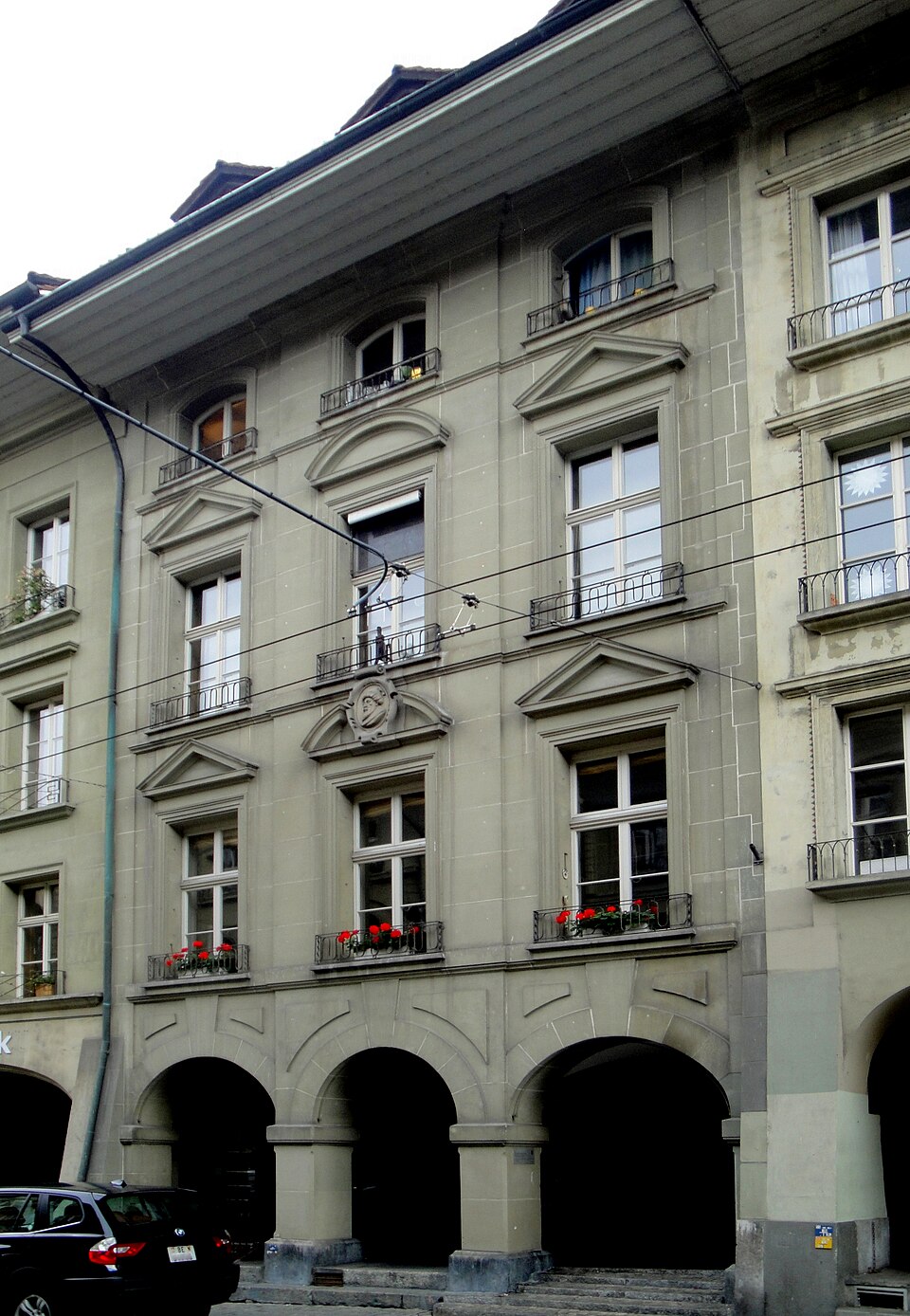
The Kaufleuten guildhall at Kramgasse 29 in Bern was built from 1718 and is regarded as a principal work of Bernese Baroque town-house architecture.

- Address
- Kramgasse 29
- Built
- 1718–1720 (HLS) or 1718–1722 (GSK)
- Architect
- Niklaus Schiltknecht (an attribution according to the HLS)
- Style
- Late High Baroque
- Today
- Guildhall of the Gesellschaft zu Kaufleuten, cultural property of national significance
- Protection
- cultural property of national significance (KGS A), worthy of protection (Bauinventar)
About the building
On Kramgasse one sandstone house follows another under the arcades. Number 29 stands out with its strictly articulated facade, only three window bays wide. It is the seat of the Gesellschaft zu Kaufleuten, one of Bern's 13 guilds and societies.
The society appears in the sources at the end of the 14th century as an association of shopkeepers. From 1431 at the latest it supervised markets and trade in the German-speaking part of the Bernese state: it checked weights and measures and appointed its own inspectors. This privilege ended in 1798 with the French invasion. Today it is a corporation of the Bern Burgergemeinde.
The house was built from 1718 to designs by Niklaus Schiltknecht (1687–1735), who in the same year became the city's master mason and later built the Heiliggeistkirche. The building dates are given differently: the Historical Dictionary of Switzerland gives 1718–1720 and calls Schiltknecht only the probable author, while the guide of the Society for the History of Swiss Art gives 1718–1722. The art guide calls it, together with the house at Spitalgasse 24, the only secular building by the architect, who died young.
What makes the facade special becomes clear in comparison with its neighbours: Schiltknecht combined the horizontal division of the storeys with a vertical emphasis on the centre, which is formed as a slightly projecting bay. The facade shows the influence of French architects from the circle of François Blondel and of theorists following Palladio. Experts see in it an early stage of Neoclassicism.
In the courtyard is one of the first free-standing staircases of the Bernese Baroque. The guild hall is panelled in cherry wood and, with its furniture and wall decoration, is considered one of the finest interiors of the early 18th century in Bern. In 1980/81 the attic was converted and several rooms were restored.
Researched and summarised by Bärn Kit. Sources: KGS-Inventar (Text GSK-Kunstführer): Zunfthaus zu Kaufleuten, KGS 749 (Archivkopie) · Historisches Lexikon der Schweiz: Niklaus Schiltknecht · Wikipedia (de): Gesellschaft zu Kaufleuten · Wikipedia (de): Kramgasse · Bauinventar der Stadt Bern: Untere Altstadt, alle Adressen (nur Liste) · Wikidata: Q9319632
Buildings nearby
House at Münstergasse 2620 mHouse at Münstergasse 3020 mTscharnerhaus on the Münsterplatz60 mTscharner House at Herrengasse 480 mGuildhall zu Pfistern80 mSamson Fountain (Simsonbrunnen)Artwork · 30 mMusica with HarpArtwork · 40 mFigures Making MusicArtwork · 40 mClassification and address: Bauinventar © Amt für Kultur des Kantons Bern · Object sheet (PDF, German) · Wikidata. Found a mistake? Write to hallo@uebrig.ch.