Organising your fridge: zones, 5 °C and a thermometer
A fridge is not equally cold everywhere. If you know what goes where and check the temperature, your food stays good for longer and you throw away less.

Why 5 degrees matters
At room temperature, germs multiply quickly. That is why the Bundesamt für Lebensmittelsicherheit und Veterinärwesen (BLV, Federal Food Safety and Veterinary Office) advises keeping meat, poultry, fish and seafood in the fridge below 5 degrees. Perishable food and leftovers should also be kept cool.
foodwaste.ch also recommends setting the fridge to 5 °C. When it is warmer, harmful microorganisms grow better and food spoils faster. The Kantonales Laboratorium Bern (the cantonal food control laboratory) says the same in its checklist for catering businesses: above 5 °C, bacteria that make people ill can multiply quickly.
The zones: what goes where
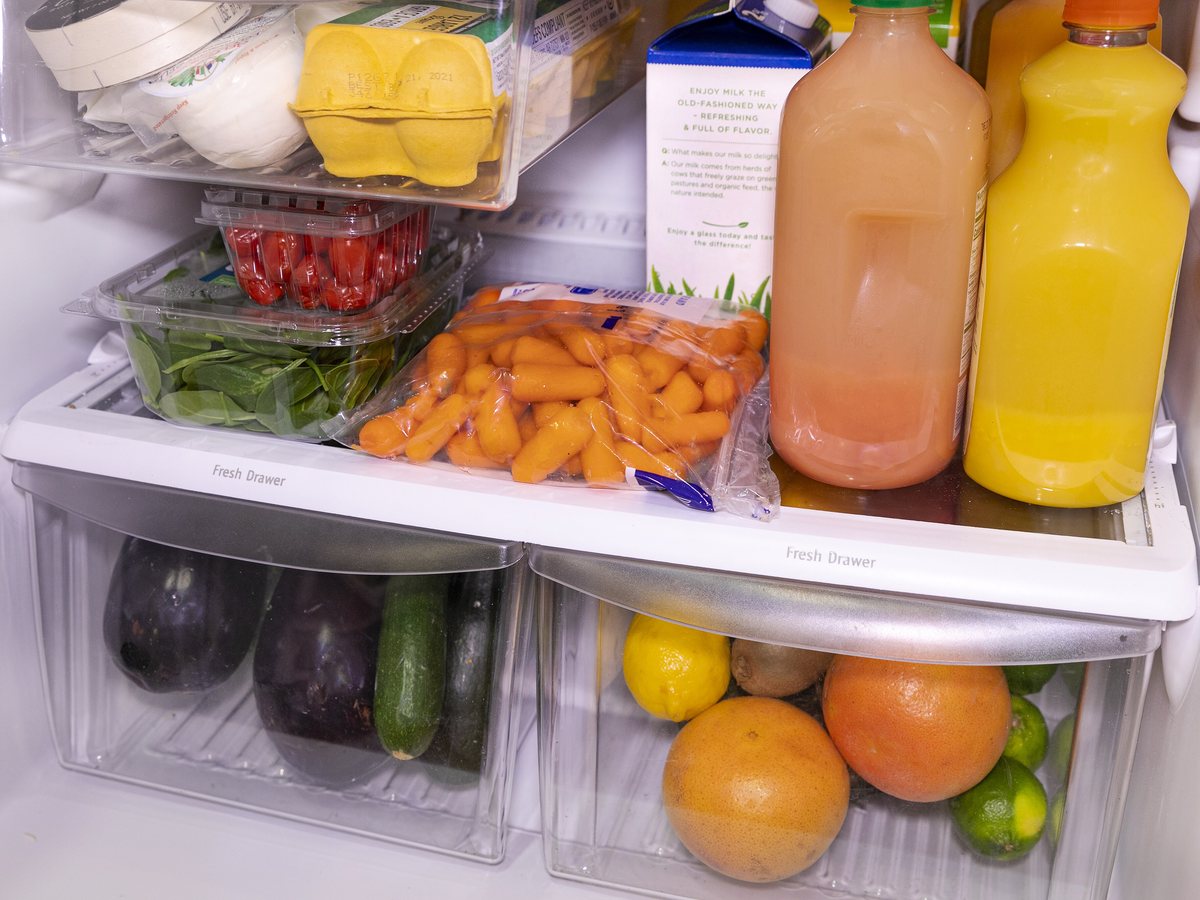
According to foodwaste.ch, the bottom shelf is the coldest zone and the top shelf the warmest. This is how to fill it:
- Bottom shelf (coldest): perishable food such as meat, fish and cold cuts, pastries, ready meals and prepared dishes.
- Middle shelf: milk and dairy products such as yoghurt, cream and cheese, eggs, plant-based milk alternatives, tofu.
- Top shelf (warmest): jam, preserves, cheese and food you will eat soon.
- Vegetable drawer: fruit and vegetables that like it cool.
- Door: drinks, opened milk, sauces, butter, preserves and tubes.
foodwaste.ch lists cheese on both the middle and the top shelf. Either is fine. According to SRF (Swiss public broadcaster), the Bundesamt für Umwelt (BAFU, Federal Office for the Environment) advised in 2022 that sensitive food such as meat, fish and raw-milk soft cheese should go at the bottom, where it is colder.
Keep raw and cooked food apart
Germs from raw food can pass to other food. The BLV therefore advises keeping raw meat and fish products separate from other food, and always storing cooked food apart from raw food. In everyday terms: raw meat and raw fish go on the bottom shelf, well wrapped or in a closed box. Cooked leftovers go next to them in their own sealed container, not open underneath.
What does not belong in the fridge
- Raw potatoes: The BLV recommends storing them dark, dry and above 8 °C. In the fridge their sugar content rises. When they are fried or baked, more acrylamide forms, a substance considered probably carcinogenic.
- Chocolate: According to foodwaste.ch, keep it dark, dry and sealed, ideally at 10 to 18 °C. It only belongs in the fridge on very hot days. A pale coating that can appear when it is stored too warm or too cool is harmless.
Read the storage instructions on the pack too. To check whether something is still good after the date, use Haltbar oder nicht? (keeps or not?).
Measure instead of guessing
Only a thermometer tells you whether your fridge really is at 5 degrees. Professional kitchens check this regularly. In its template for childcare centres, the Kantonales Laboratorium Bern gives these target values:
- Fridge and cold room: no more than 5 °C
- Fish: no more than 2 °C
- Freezer: −18 °C or colder
There, temperatures are checked every day and written down at least once a week. If a value is off, you note what you did about it. In its checklist for catering businesses, the laboratory advises buying a probe thermometer and setting temperatures and check intervals for every cooling unit.
At home you do not need to write anything down. But a simple thermometer on the bottom and the middle shelf quickly shows you whether the setting is right.
Order helps against food waste
In a tidy fridge, less gets forgotten at the back. Tips from foodwaste.ch:
- First in, first out: new things to the back, older things to the front.
- Mark it: anything that needs eating soon gets a note, for example “Iss mich bald” (eat me soon).
- Leftovers in sealed containers: decant even small leftovers and chill them quickly. Clear containers help you keep track.
- Let warm food cool briefly: let warm dishes cool a little after decanting, then put them in the fridge. That saves energy, and the other food does not warm up.
Add three rules from the BLV: put chilled and frozen products into the fridge or freezer straight after shopping. Do not refreeze food that has thawed. Heat cooked dishes to 70 degrees again when you reheat them. For leftover ideas, see the Reste-Küche (leftovers kitchen).
5 or 7 degrees?
In August 2022, according to SRF, the Federal Council recommended setting fridges from 5 to 7 degrees to save electricity. An expert at ZHAW (Zurich University of Applied Sciences) calculated at the time that, for a modern, efficient fridge, the energy saved is lost if around 50 grams more beef spoils in a year. The Federal Office of Energy replied that more food waste caused by the higher temperature had not been confirmed.
For safety, the BLV advice remains clear: meat, poultry, fish and seafood below 5 degrees. So if you want to save electricity, do not simply set the fridge warmer. At least keep these foods in the coldest part and measure the temperature there.
For kitchens and associations in Bern
If you pass food on, for example at a festival or from a canteen, further rules apply. They are in Passing on food safely. With the free tool übrig you go through seven hygiene questions before you pass on a dish, and keep a log. Everything stays in your browser.
This article is for information and is not legal advice. In the Canton of Bern, the binding authority is the Kantonales Laboratorium (food control).
Sources
- BLV: Hygiene im Umgang mit Lebensmitteln (food hygiene): below 5 degrees, keep apart, do not refreeze, 70 degrees.
- BLV: Acrylamid (acrylamide): store raw potatoes above 8 °C.
- foodwaste.ch: 5 Schritte gegen Food Waste (5 steps against food waste): 5 °C, zones, first in – first out, leftovers.
- foodwaste.ch: Schokolade und Kakao (chocolate and cocoa): storage at 10 to 18 °C.
- Kantonales Laboratorium Bern: Muster-Dokumentation Selbstkontrolle für Kitas (template for childcare centres, Word, German): target values and temperature checks.
- Kantonales Laboratorium Bern: self-check checklist for catering businesses (Word, German): bacteria above 5 °C, probe thermometer.
- SRF Espresso (25 October 2022): higher fridge temperature: the 2022 recommendation, the ZHAW calculation, replies from BFE and BAFU.
- Canton of Bern: Kantonales Laboratorium: the control authority.
Also worth reading
Passing on food safelyArticleBest before or use by?ArticleHaltbar oder nicht? (keeps or not?)ToolReste-Küche (leftovers kitchen)ToolText: Richard Červenka, Bärn Kit. Found a mistake? Write to hallo@uebrig.ch.