Passing on food safely: temperature, cold chain, labels and allergens – what Swiss law requires
Giving leftover food away counts as placing it on the market, even for free. Here are the rules on temperature, cold chain, labels, records and allergens, and how übrig helps.

Free does not mean rule-free
The Lebensmittelgesetz (LMG, Food Act) counts any free hand-over as “Inverkehrbringen”, placing on the market (Art. 6 LMG). Only safe food is allowed (Art. 7 LMG). Only cooking at home for your own household is exempt (Art. 2 para. 4 LMG). So restaurants and canteens giving food away follow the same rules as when selling it.
Anyone handling food must register with the cantonal authority; only occasional small hand-outs, such as at bazaars, are exempt (Art. 20 LGV). In the Canton of Bern you register your business with the Kantonales Laboratorium (Cantonal Laboratory).
Since 1 February 2024 the law defines “Umverteilung” (redistribution): collecting, storing and distributing surplus safe food that would otherwise be binned (Art. 2 para. 1 no. 32 LGV). Food businesses that redistribute check at least date, packaging, storage and transport temperatures, look, smell, taste and traceability (Art. 27a HyV). More on dates: “Best before” or “use by”.
Self-checks: you are responsible
Anyone who produces, stores, transports or hands out food must run “Selbstkontrolle” (self-checks); official inspections do not replace them (Art. 26 LMG). They match the risk and size of the business (Art. 74 LGV). They include good practice, HACCP procedures, traceability, recall and documentation (Art. 75 LGV, Art. 78 LGV).
The Kantonales Laboratorium Bern lists four steps: describe the business, analyse hazards, write work instructions, document your own checks. Trade associations may write guidelines for this; the BLV (Federal Food Safety and Veterinary Office) approves them (Art. 80 LGV). For restaurants this is the “Leitlinie Gute Verfahrenspraxis im Gastgewerbe (GVG)” by GastroSuisse, approved on 21 September 2018. According to the BLV, guidelines are not ordinances; the law always takes precedence.
Hot at least 65 °C, cold at most 5 °C
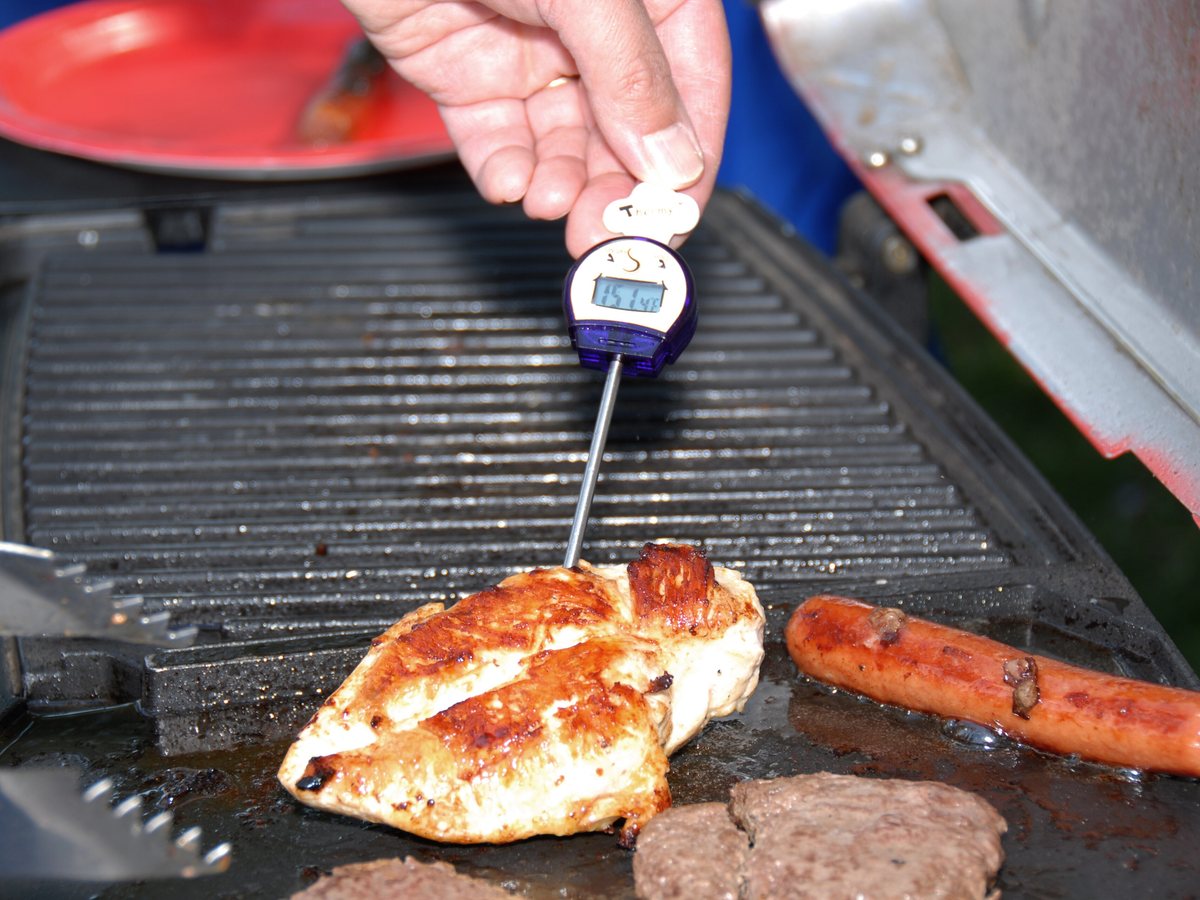
The Hygieneverordnung (HyV, Hygiene Ordinance) requires temperature rules to be kept and the cold chain unbroken (Art. 3 HyV). Brief deviations are allowed only when necessary, for example in transport, and if nobody is put at risk (Art. 24 HyV). Food passed on cold must be cooled as fast as possible; food kept warm must be hot enough to stop germs multiplying. Check both with a thermometer as part of your self-checks (Art. 27 HyV).
Fixed figures for ready dishes come from good practice, not the law itself. The Kantonales Laboratorium Basel-Stadt sums them up in its fact sheet from May 2026:
- Cooking: at least 72 °C in the core, for 2 minutes. The fact sheet gives 70 °C as the minimum; übrig and the Vereinsfest-Küche use the stricter 72 °C.
- Keeping warm: at least 65 °C all the way until serving, as briefly as possible (at most three hours, depending on the product).
- Cooling: pass through 10 to 50 °C within two hours at most, cool actively in flat layers up to 6 cm, never at room temperature.
The Kantonales Laboratorium Bern, in its model documentation for day-care centres, gives these values: fridge at most 5 °C, hot food delivered at least 65 °C. Its checklist for catering businesses notes that harmful bacteria can multiply quickly above 5 °C.
On the way: clean container, the right box
Transport containers must be clean and protect the food from contamination (Art. 12 HyV). Packaging must not be a source of contamination either (Art. 19 HyV). In practice: lid on, cool box or hot box, temperature measured at hand-over.
Label and log: who, what, when
Food must be traceable through every stage (Art. 28 LMG). You must be able to tell the authority who supplied you and whom you supplied, except for direct hand-over to consumers (Art. 83 LGV). HACCP principles also include records proving you keep to your measures (Art. 79 LGV). A label with dish, preparation time, deadline and allergens, plus a hand-over note, covers much of this.
Allergens: also when giving food away
The Verordnung betreffend die Information über Lebensmittel (LIV, Food Information Ordinance) lists 14 groups that must always be declared: cereals containing gluten, crustaceans, eggs, fish, peanuts, soy, milk including lactose, nuts, celery, mustard, sesame, sulphites above 10 mg per kg or litre, lupin and molluscs (Annex 6 LIV). Unpackaged food carries the same information duty as packaged food (Art. 39 LGV). Oral information is allowed only with a clearly visible written notice, and if staff have the details in writing or an expert can answer at once (Art. 5 LIV). The cook is not there later, so allergens go with the food in writing; the Allergen-Poster helps.
How übrig helps, and where it stops
übrig is a free browser tool, with no account and no server. “Prüfen” (check) asks seven questions, for example about 65 °C, 5 °C, cool or hot boxes and the 14 allergens. “Meldung” (report) and “Etikett” (label) record dish, allergens and “Zu verbrauchen bis” (use by), with the note “Vor dem Servieren durcherhitzen” (reheat thoroughly before serving). The “Protokoll” (log) stays only in your browser. More in How übrig works safely. For club events, try the Vereinsfest-Küche.
At übrig, cooked food is meant only for night shelters and social institutions, such as the Gassenküche or Punkt 6. Public fridges such as Madame Frigo take no cooked food. Before the first hand-over, you call and agree the conditions. Until hand-over, the business is responsible. The pilot has not started yet. Read on: Saving food in Bern, Food waste in Switzerland and Bern and the checklist for restaurants.
This article is information, not legal advice. In the Canton of Bern, the binding authority is the food control of the Kantonales Laboratorium. Whether the receiving organisation counts as a food business is best clarified there.
Sources
- Food Act LMG, SR 817.0: Art. 2, 6, 7, 26, 28.
- Foodstuffs and Utility Articles Ordinance LGV, SR 817.02: Art. 2, 20, 39, 74, 75, 78, 79, 80, 83.
- Hygiene Ordinance HyV, SR 817.024.1: Art. 3, 12, 19, 24, 27, 27a.
- Food Information Ordinance LIV, SR 817.022.16: Art. 5, Annex 6.
- BLV: good practice guidelines: GVG, approved 21 September 2018.
- Kantonales Laboratorium Basel-Stadt: temperature fact sheet (2026): 70 °C, 65 °C, cooling.
- Kantonales Laboratorium Bern: model self-check documentation: 5 °C and 65 °C.
- Kantonales Laboratorium Bern: self-check checklist: bacteria above 5 °C.
- Canton of Bern: setting up self-checks and registering a food business.
Also worth reading
“Best before” or “use by”ArticleChecklist for restaurants and canteensArticleHow übrig works safelyArticleübrig: check, label, logToolAllergen-PosterToolText: Richard Červenka, Bärn Kit. Found a mistake? Write to hallo@uebrig.ch.