Bern Historical Museum
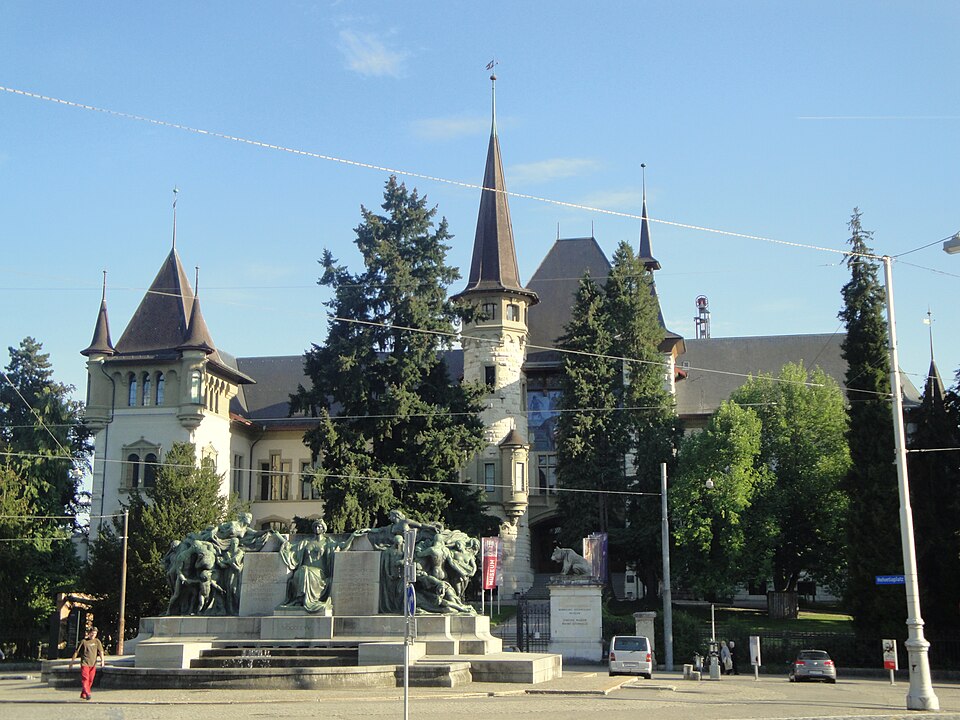
The Bern Historical Museum on Helvetiaplatz is a historicist castle-like building of the 1890s, originally intended for a Swiss national museum.

Visiting
- Getting there
- Tram 6, 7, 8 or bus 19 to the stop “Helvetiaplatz”.
- Open
- Tuesday to Sunday 10 am to 5 pm, Monday closed.
- Admission
- Adults from CHF 16, children 6 to 16 from CHF 8; with the Einstein Museum CHF 18 and 9.
- Access
- The building from 1894 is only partly step-free.
- Tip
- The Einstein Museum is inside the Bernisches Historisches Museum.
Checked 24 October 2026. Sources: Bernisches Historisches Museum – Praktische Infos · Bern Welcome – Einstein Museum
- Address
- Helvetiaplatz 5
- Built
- 1892–1894 (Wikipedia) or 1892–1896 (building inventory); extension 1918–1922; new wing 2009
- Architect
- André Lambert; site management Eduard von Rodt
- Style
- Historicism (castle style)
- Today
- Museum of cultural history with the Einstein Museum
- Protection
- cultural property of national significance (KGS A), worthy of protection (Bauinventar)
About the building
Coming over the Kirchenfeld Bridge, you see at the end of Helvetiaplatz a building that looks like a castle: towers, oriels, battlements and a steep hipped roof. Above the open staircase and the entrance hall glows a colourful glass mosaic by Léo-Paul Robert that depicts the ages of history. In front of it stands the World Telegraph Monument.
The form has a reason. In 1889 the canton, the city and the Burgergemeinde of Bern set up a foundation for a Swiss National Museum, and Bern used this project to bid for its location. The individual parts of the building were meant to show architectural forms from different periods and regions of the country. Zurich won the contest for the site; Bern built anyway, now as its own museum, and from 1893 the foundation was called Bern Historical Museum. The design was by André Lambert of Stuttgart, and construction was managed by Eduard von Rodt. The sources give different years for the construction: Wikipedia from late 1892 to 1894, the building inventory 1892 to 1896 for the execution including annexes. The building stands on the site where Bern had celebrated its 700th anniversary.
The side wings towards the square are designed as late Gothic halls with stepped windows, and at the corners stand a tower and a richly carved oriel in late Renaissance forms. On the courtyard side a tower with a Käsbissen roof stands out, a saddle roof between two stepped gables. In 1914 Henri Moser gave the museum his Oriental collection together with funds for an extension. This Moser wing was built from 1918 to 1922 to plans by René von Wurstemberger, a massive block whose upper exhibition hall has no windows.
The facades were renovated from 1997 to 2002. In 2009 the extension by the Biel firm :mlzd opened, with a large hall for temporary exhibitions. The museum holds about 500,000 objects, among them the Burgundian tapestries and, since 2005, an Einstein Museum. The building is a cultural property of national importance.
A detail to look for: the oriel at the north-west corner with its fine sculpted decoration.
Researched and summarised by Bärn Kit. Sources: Bauinventar der Stadt Bern: Helvetiaplatz 5, 5A, 5D · Wikipedia (de): Bernisches Historisches Museum · Wikidata: Q670058
Buildings nearby
Swiss Shooting Museum60 mApartment house at Bernastrasse 10100 mResidential and commercial building at Thunstrasse 4110 mHouses with shops at Thunstrasse 6/8120 mHouse with restaurant at Thunstrasse 5120 mL'Histoire et la Poésie (History and Poetry)Artwork · 20 mEntrance gate with bearsArtwork · 50 mSoldier sceneArtwork · 60 mMore sights in Bern
Zentrum Paul KleeMuseumsKunstmuseum BernMuseumsClassification and address: Bauinventar © Amt für Kultur des Kantons Bern · Object sheet (PDF, German) · Wikidata. Found a mistake? Write to hallo@uebrig.ch.