Engepromenade
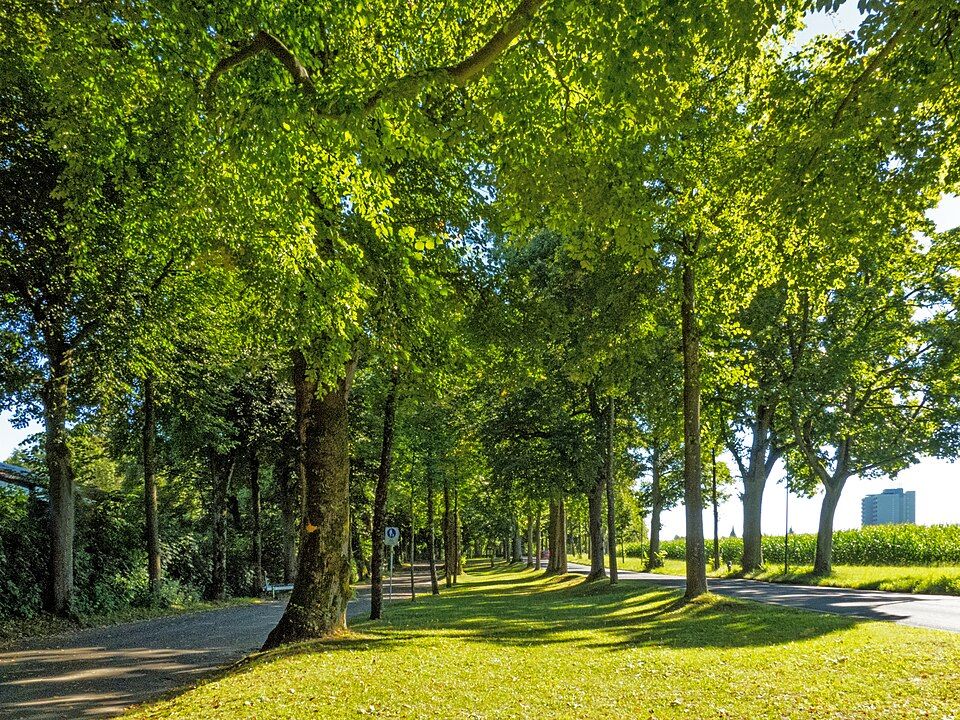
The Engepromenade along Engestrasse in Bern was laid out as a double avenue in 1738/40 and 1753 and long remained a popular walk for the city.

- Address
- Engepromenade, 3004 Bern
- Built
- 1738/40 and 1753; additions 1928, 1947, 1964
- Architect
- laid out under Viererobmann Samuel Ludwig Gruber
- Style
- Baroque promenade (double avenue)
- Today
- Public avenue with fountain and soldiers' memorial, cultural property of regional significance
- Protection
- cultural property of regional significance (KGS B)
About the building
Engestrasse leads out of the city onto the Enge peninsula on the Aare. Between the Inner and the Outer Enge it is accompanied by a broad walk: the Engepromenade, a layout from the 18th century.
It was laid out in two stages, in 1738/40 and 1753, under Samuel Ludwig Gruber, who then held the office of Viererobmann. According to the historical-topographical lexicon of the city of Bern, the result was a double path with elms, walls of foliage, lawns and benches. The footpath ran east of a cowherd's house and the carriage road west of it. The Historical Dictionary of Switzerland cites the Engeallee as an example of the new promenades of the 18th century, on which carriages and pedestrians had separate paths.
According to the building inventory, the stretch of road between the Inner and Outer Enge was developed as a double avenue in 1753 and then became one of Bern's most popular promenades. The Enge peninsula was close to the city and yet secluded; in the 19th century it drew the middle classes for walks, drives and rides, and garden restaurants sprang up along its paths. For a time the road was called Reichenbachstrasse, and since the second half of the 19th century it has again been called Engestrasse.
In the 20th century the promenade was extended: play and rest areas were added in 1928, and a fountain at the end of 1947. On 1 August 1964 the soldiers' memorial was inaugurated. The fountain and the memorial are now part of the site, which is classed as a cultural property of regional significance.
Walking along the promenade, you follow a route that has existed for almost three centuries. Notice the separation of footpath and road, which was already planned in the 18th century.
Researched and summarised by Bärn Kit. Sources: Burgerbibliothek Bern: Engeallee (nach Berchtold Weber, Historisch-Topographisches Lexikon der Stadt Bern) · Historisches Lexikon der Schweiz: Parkanlagen · Bauinventar der Stadt Bern: Quartiergeschichte Enge-Felsenau · Wikipedia (de): Liste der Kulturgüter in Bern/Länggasse-Felsenau · Wikidata: Q56413444
Buildings nearby
Altersheim Jolimont630 mFelsenau Viaduct670 mFreies Gymnasium Bern school building700 mQuartierhof720 mSt. Mary's Church (Marienkirche)790 mSoldiers' MemorialArtwork · 80 mUntitled (Portrait of Pestalozzi)Artwork · 280 mCommunicating VesselsArtwork · 290 mClassification and address: Bauinventar © Amt für Kultur des Kantons Bern · Wikidata. Found a mistake? Write to hallo@uebrig.ch.