Melchenbühl Country Estate
The Melchenbühl estate in the east of Bern is a Régence country house on a hilltop, with a garden, a barn and a long history as a charitable foundation.

- Address
- Melchenbühlweg 156
- Built
- c. 1730–1735 (building inventory) or manor house 1692 with roof changes in the 1770s and after 1800 (lexicon)
- Style
- Régence
- Today
- since 1980 Terra vecchia (live-and-work community) according to the lexicon; cultural property of regional importance
- Protection
- cultural property of regional significance (KGS B), worthy of protection (Bauinventar)
About the building
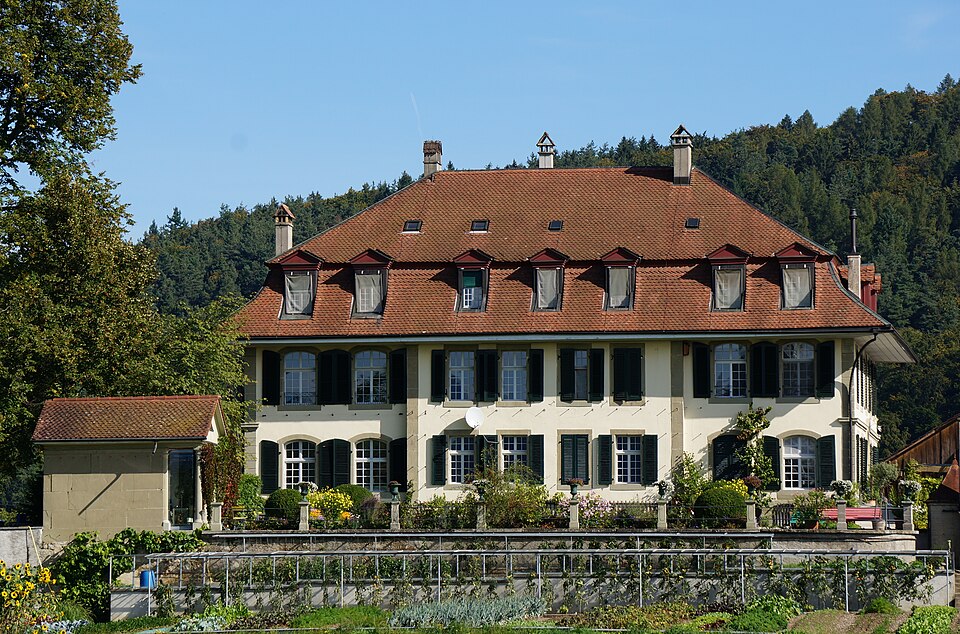
On a hilltop on the slope of the Dentenberg, on the old route from Bern to the Bernese Oberland, stands the manor house of the Melchenbühl estate. The wide, two-storey rendered building with sandstone dressings has a far-projecting mansard roof with dormers on all sides. The long sides are eight window bays wide; on the south-west side the four central bays project. The city's heritage office regards it as a typical Régence building whose effect comes from its clear order and well-balanced proportions.
Sources differ on when the present house was built. The building inventory gives a new building around 1730 to 1735. The Historical-Topographical Lexicon of the City of Bern, by contrast, dates the manor house to 1692; it says a new hipped roof was added in the 1770s and converted to a mansard roof shortly after 1800. The later additions are undisputed: a polygonal oriel was added on the north-west side in 1915 and a terrace on the west in 1928.
The property goes back to the farmers Hans and Heinrich Krieg, mentioned around 1609. For more than two centuries it then belonged to various Bernese patrician families, among them the von Wattenwyl, Stettler and Manuel, who spent the summer here. In 1855 the German merchant C. G. Müller bought the estate; his son-in-law Jean Berset farmed it himself. In 1898 Marie Berset-Müller left it through a foundation to the Swiss Confederation, on condition that a home for disabled and needy women teachers be set up. Since 1980, according to the lexicon, the estate has served under the name Terra vecchia as a place to live and work for the reintegration of people with drug addiction. The large barn from the mid-18th century shows that farming always mattered here.
The grounds include a garden wall of sandstone blocks, a garden pavilion with columns under a gabled roof and remains of a geometric garden, together with old chestnut, lime and maple trees. According to the lexicon, the name refers to the small hill where cows grazing freely used to be milked. A detail to look for: the fountain placed exactly on the axis of the manor house.
Researched and summarised by Bärn Kit. Sources: Bauinventar der Stadt Bern: Melchenbühlweg 156 · Bauinventar der Stadt Bern: Baugruppe Landsitz Melchenbühl · Historisch-Topographisches Lexikon der Stadt Bern: Melchenbühl · Wikipedia (de): Liste der Kulturgüter in Bern/Kirchenfeld-Schosshalde (Nord) · Wikidata: Q29651702
Buildings nearby
Farm of Wittigkofen Castle at Melchenbühlweg 139780 mBarn at Melchenbühlweg 137d800 mHenzistock on Melchenbühlweg820 mTenant farmer’s house at Melchenbühlweg 136840 mWittigkofen Castle850 mUntitledArtwork · 660 mWormArtwork · 680 mUntitledArtwork · 700 mClassification and address: Bauinventar © Amt für Kultur des Kantons Bern · Object sheet (PDF, German) · Wikidata. Found a mistake? Write to hallo@uebrig.ch.