Federal Palace (Bundeshaus)
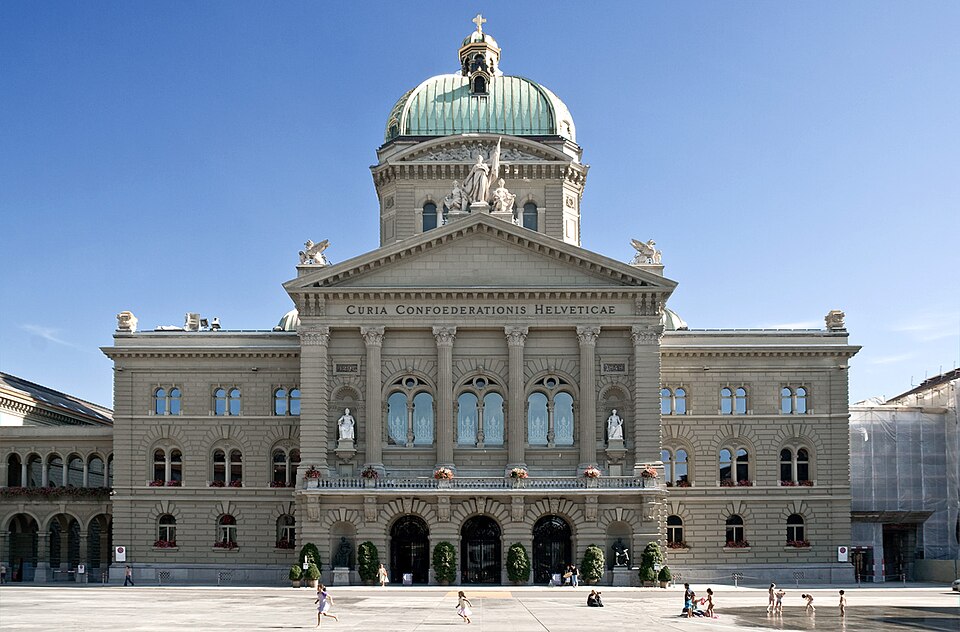
The Federal Palace in Bern is the seat of Switzerland's government and parliament; the domed parliament building was built from 1894 to 1902.

Visiting
- Getting there
- Bus 10 or 19 to the stop “Bundesplatz”.
- Open
- Inside only on a guided tour (Tuesday to Saturday) or, during the sessions, as a visit to the public gallery.
- Admission
- Free, tours and gallery.
- Tip
- Book tours online, at the earliest three days ahead; visitors aged 16 and over bring an official ID. There are no tours during the sessions.
Checked 24 October 2026. Sources: Swiss Parliament – Guided tours of the Parliament Building · Bern Welcome – Parliament Building and Parliament Square
- Built
- West wing 1852–1857; East wing 1884/1888–1892; parliament building 1894–1902
- Architect
- Hans Wilhelm Auer (East wing and parliament building), Jakob Friedrich Studer (West wing)
- Style
- Neo-Renaissance; West and East wings in round-arch style
- Today
- Seat of the Federal Council and the Federal Assembly
- Protection
- cultural property of national significance (KGS A)
About the building
From Bundesplatz you see the north facade of the parliament building with its temple-like portico and the green dome above it. At the very top, at about 60 metres, a gilded Swiss cross shines. To the left and right adjoin the West and East wings, together a symmetrical complex just over 300 metres long. It is listed in the inventory of cultural property of national importance.
The oldest part is the West wing, built from 1852 to 1857 as the "Federal Town Hall" by Jakob Friedrich Studer. It brought the administration, the government and both chambers of parliament under one roof and soon became too small. It was followed by the mirror-image East wing, from 1884 to 1892 according to Wikipedia, from 1888 to 1892 according to the Historical Dictionary of Switzerland. The commission went to Hans Wilhelm Auer, although Alfred Friedrich Bluntschli had won the competition. Auer also designed the parliament building in the middle; the Federal Council chose his design on 30 June 1891. The Confederation bought the site of the old Casino from the city, construction began on 5 September 1894, and the building was handed over on 1 April 1902. It cost 7.2 million francs, 16.2 per cent of which went on the artistic decoration.
Auer wanted the building to represent the whole of Switzerland. 38 artists from all parts of the country created statues, murals, stained glass and mosaics on three themes: the country's history, the foundations of the constitution and the diversity of its regions and professions. About 30 kinds of stone from 13 cantons and half-cantons were used. On the portico, golden dates recall 1291 and 1848, and below them stands "Curia Confoederationis Helveticae". The copper dome was reddish at first and only acquired its green patina after about a quarter of a century. Its drum has 22 windows, as many as there were cantons at the time.
From 2006 to 2008 the parliament building was comprehensively renovated for the first time, under the direction of the firm Aebi & Vincent; the costs finally came to 103 million francs. On 12 September 2023 the long-empty pediment received a work of 246 ceramic tiles, one for each member of parliament. Its title "Tilo" recalls Tilo Frey, the first Black member of the National Council.
A detail to look for: the 22 windows in the drum of the dome, one for each canton of 1902.
Researched and summarised by Bärn Kit. Sources: Wikipedia (de): Bundeshaus (Bern) · Johannes Stückelberger: „Bundeshaus“, Historisches Lexikon der Schweiz (HLS) · Wikidata: Q30911
Buildings nearby
Cantonal Bank Building on Bundesplatz80 mSwiss National Bank building80 mThe so-called Kaiserhaus130 mKäfigturm170 mBurgerhaus on Amthausgasse180 mHistorian of the PresentArtwork · 20 mTiloArtwork · 20 mHistorian of the PastArtwork · 20 mMore sights in Bern
ZytgloggeOld town and landmarksBern MinsterOld town and landmarksKäfigturmOld town and landmarksErlacherhofOld town and landmarksFormer Kornhaus (Granary)Old town and landmarksRathaus zum Äusseren StandOld town and landmarksClassification and address: Bauinventar © Amt für Kultur des Kantons Bern · Wikidata. Found a mistake? Write to hallo@uebrig.ch.