Zytglogge
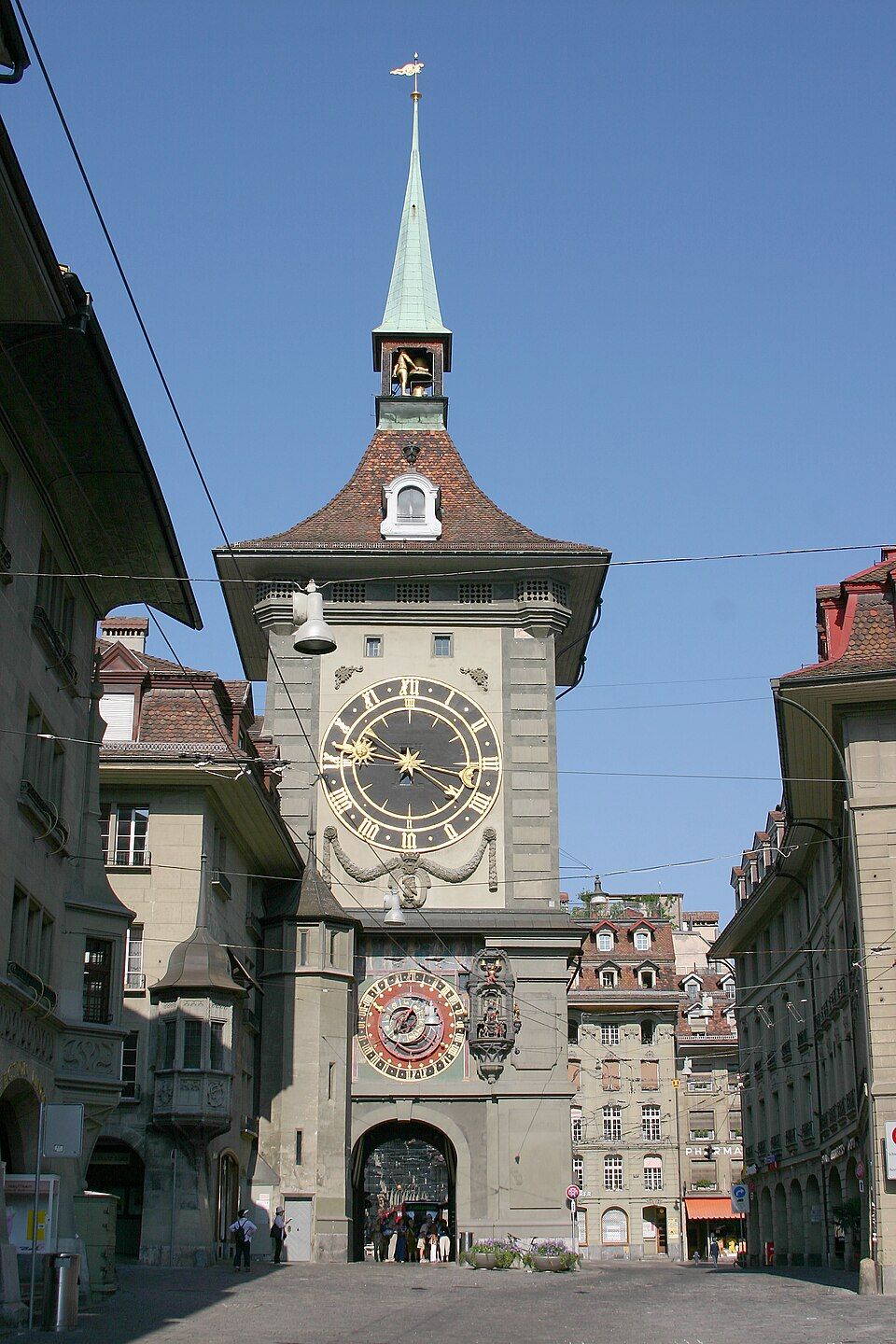
The Zytglogge in Bern's old town was a city gate and a prison, and since the 15th century it has been a clock tower with an astronomical clock.

Visiting
- Getting there
- Tram 6, 7, 8, 9 or bus 10, 12, 19 to the stop “Zytglogge”.
- Open
- Always visible from outside; the figure play runs every hour on the hour. Inside only on a guided tour by Bern Welcome.
- Admission
- Public tour from CHF 12.
- Access
- The tour climbs about 130 steps, not step-free.
- Tip
- The tour lasts one hour, meeting point at the tower on Kramgasse. At the top, a view over the old town and, in clear weather, the Bernese Oberland.
Checked 24 October 2026. Sources: Bern Welcome – Tour of the Clock Tower · Bern Welcome – Zytglogge
- Address
- Bim Zytglogge 3
- Built
- 1218–1220; rebuilt after 1405; altered 1770/71
- Architect
- Clockwork by Kaspar Brunner (1530); 1770/71 alterations by Niklaus Hebler and Ludwig Emanuel Zehnder
- Style
- Medieval gate tower, remodelled in late Baroque
- Today
- Clock tower with astronomical clock and figure play; cultural property of national importance
- Protection
- cultural property of national significance (KGS A), worthy of protection (Bauinventar)
About the building
The Zytglogge, Bernese German for „time bell“, stands at the upper end of Kramgasse. It was built between 1218 and 1220 as a gate tower on the western edge of the city founded in 1191. Because Bern, inside the loop of the Aare, could only grow westwards, the tower moved further inside the city with each extension. It lost its role as a defensive tower and was then used as a prison.
In the great city fire of 1405 the tower burned out. When it was rebuilt it received a clock and a large bell, cast in October 1405 by Master Johann Reber of Aarau; it weighs about 1,400 kilograms and still hangs in the tower. The clock set the time for the whole city, and distances in hours of walking were measured from the tower. In 1530 Kaspar Brunner built the clockwork that still runs today. Measures of length are fixed in the gateway for public checking. The tower got its present late Baroque form in the alterations of 1770/71. Its total height is 54.5 metres.
On the east side, below the large clock face, is the astronomical clock, which goes back in its essentials to 1405/06. It shows the Earth at the centre, circled by the sun, moon and stars, along with the sign of the zodiac, the phase of the moon, the day of the week and the date. Shortly before the full hour the figure play begins: a rooster crows, a jester rings two small bells, a procession of armed bears passes by, Chronos turns his hourglass, and up in the spire a gilded figure called Hans von Thann strikes the hour. This is how the German Wikipedia and Bern Welcome describe it; the English Wikipedia, by contrast, equates Hans von Thann with Chronos.
From 1981 to 1983 the tower was thoroughly restored and largely returned to its 1770 appearance. Since 1930 the west side has carried the mural „Beginn der Zeit“ (Beginning of Time) by Victor Surbek. On guided tours you climb about 130 steps and see the clockwork from inside. The Zytglogge is cultural property of national importance and part of the UNESCO World Heritage Site of the Old City of Bern.
Researched and summarised by Bärn Kit. Sources: Wikipedia (de): Zytglogge · Wikipedia (en): Zytglogge · Bern Welcome: Zytglogge (Zeitglockenturm) · Bauinventar der Stadt Bern: Untere Altstadt (Übersicht) · Wikidata: Q246105
Buildings nearby
House at Bim Zytglogge 110 mHôtel de Musique50 mPatrician house at Kornhausplatz 250 mHauptwache (main guardhouse)90 mGuild House zu Mittellöwen100 mUntitledArtwork · 0 mThe Beginning of Time (or Expulsion from Paradise)Artwork · 10 mBanner BearerArtwork · 30 mMore sights in Bern
Bern MinsterOld town and landmarksFederal Palace (Bundeshaus)Old town and landmarksKäfigturmOld town and landmarksErlacherhofOld town and landmarksFormer Kornhaus (Granary)Old town and landmarksRathaus zum Äusseren StandOld town and landmarksClassification and address: Bauinventar © Amt für Kultur des Kantons Bern · Object sheet (PDF, German) · Wikidata. Found a mistake? Write to hallo@uebrig.ch.