Heiligkreuz Church (Holy Cross)
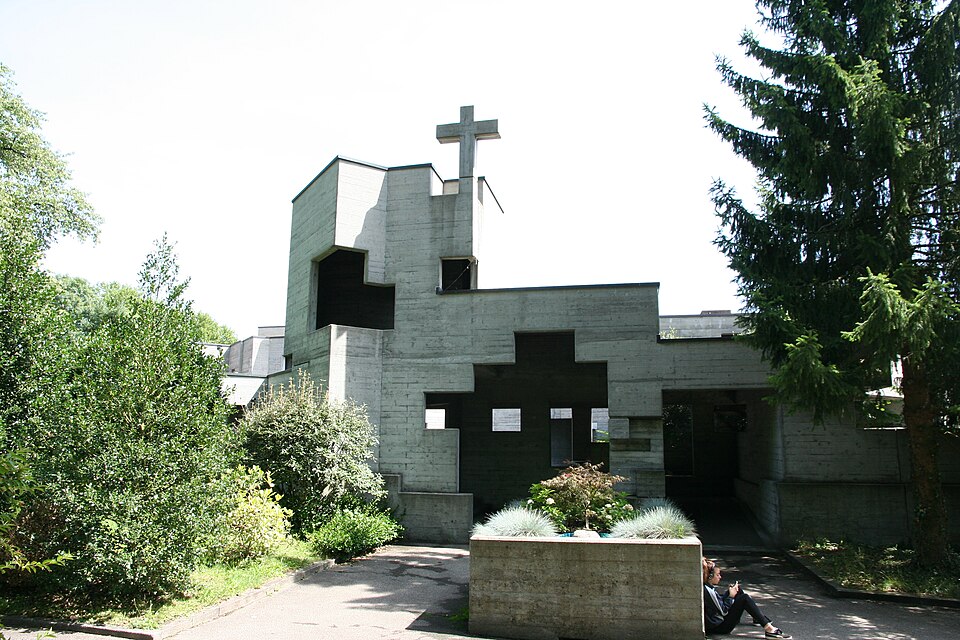
Heiligkreuz church at Kastellweg 7 in Tiefenau is an exposed-concrete building of 1969 by Walter Maria Förderer; today it is Romanian Orthodox.

- Address
- Kastellweg 7
- Built
- 1966–1968 (building inventory); ground broken 1967, consecrated 1 June 1969 (Wikipedia)
- Architect
- Walter Maria Förderer
- Style
- Brutalism (exposed concrete)
- Today
- Romanian Orthodox Church of St George (since 2018)
- Protection
- worthy of protection (Bauinventar)
About the building
Walking past on Kastellweg in Tiefenau, you would hardly recognise the church as one. The parsonage stands at the crossroads and hides the church space, the building is low, and instead of a tall tower there is only a bell frame with a concrete cross. Everything is cast in exposed concrete, church, parsonage and parish centre alike. That sets the complex apart from all the buildings around it. The city's building inventory sees it as one of the earliest and most important buildings in Bern conceived as a single sculpture in concrete.
Tiefenau's population grew strongly in the 1940s and 1950s, and from 1956 the local Catholics held their services in a hall of the nearby Tiefenau hospital. In 1959 and 1964 the parish association bought land on Kastellweg, and in 1962 the parish was founded. The 1963 competition was won by Walter Maria Förderer, then still in partnership with Rolf Georg Otto and Hans Zwimpfer. For structural reasons the project was revised and turned out less monumental; instead of three bells only one rings, cast in 1968 by the Rüetschi foundry in Aarau. The building inventory gives the construction period as 1966 to 1968; according to Wikipedia, ground was broken on 18 March 1967 and the church was consecrated on 1 June 1969.
Förderer (1928–2006) had trained as a sculptor and saw his churches as sculptures you can walk into. The plan follows a polygonal grid. You enter beneath the bell frame into a courtyard; from there the route leads in a circular movement inside and up to the altar. The pews stand in a semicircle around the altar, as the Second Vatican Council required, and the font is also placed in the chancel. Twelve pillars for the apostles and one pillar with a cross for Christ carry the stepped ceiling. Light enters only through small square openings. In style the building belongs to Brutalism, which drew on Le Corbusier's late works.
Heiligkreuz is Förderer's only church in the Canton of Bern. The building inventory compares it with his Heiligkreuz church in Chur, built at the same time; next to that, it says, the Bern building seems almost rural and modest. The interior was renovated in 2011. Because the Catholic congregation needed the church less and less and the upkeep of the concrete building was expensive, it was deconsecrated on 21 January 2018 and handed over to the Romanian Orthodox parish of St George, which reconsecrated it in April 2018.
Researched and summarised by Bärn Kit. Sources: Bauinventar der Stadt Bern: Kastellweg 7 · Historisches Lexikon der Schweiz: Förderer, Walter Maria · Wikipedia (de): Heiligkreuz (Bern) · Wikidata: Q16058576
Buildings nearby
Reformed Church of St Matthew170 mEngehalbinsel (Enge Peninsula)210 mFelsenau Viaduct680 mAltersheim Jolimont750 mFormer Bern Slaughterhouse1060 mLegionary (fountain figure)Artwork · 80 mBrenodoraArtwork · 110 mSolid Angle HorizontalArtwork · 130 mClassification and address: Bauinventar © Amt für Kultur des Kantons Bern · Object sheet (PDF, German) · Wikidata. Found a mistake? Write to hallo@uebrig.ch.