Altenbergsteg
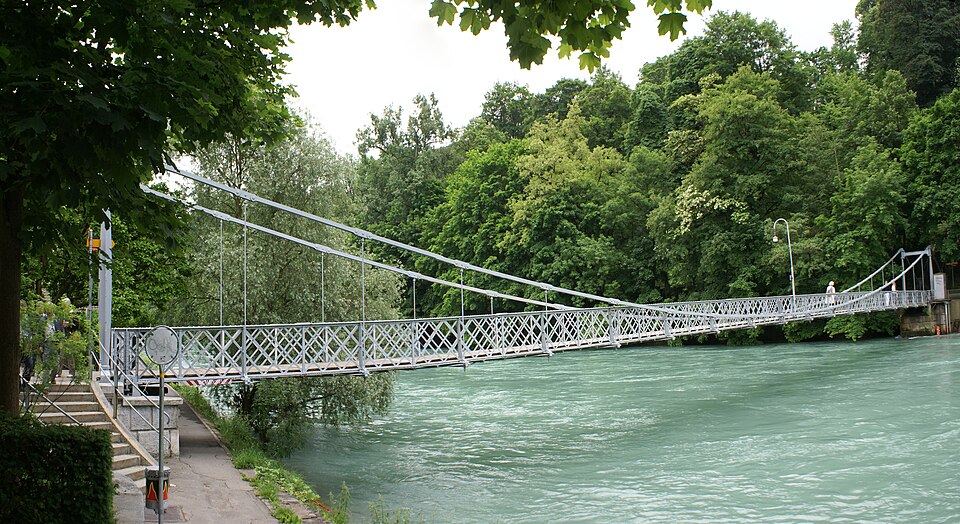
The Altenbergsteg of 1857 is an iron chain footbridge that crosses the Aare just above the water, linking Bern's old town with the Altenberg.

- Address
- Altenbergsteg
- Built
- 1857 (opened 2 October 1857)
- Architect
- Engineer Friedrich Gustav Gränicher, with Niklaus Riggenbach
- Style
- Iron chain bridge of early historicism
- Today
- Footbridge over the Aare, cultural property of national importance
- Protection
- cultural property of national significance (KGS A), worthy of protection (Bauinventar)
About the building
Below the old town, two bridges cross the Aare at the same spot: high above, the great arch of the Kornhausbrücke of 1898, and underneath, only a little above the water, the narrow Altenbergsteg. It is about 57 metres long and 2.1 metres wide and leads to the Altenberg on the north bank. Vehicles such as bicycles or mopeds are not allowed on it.
A ferry crossed the river here from 1823. In 1834 it was replaced by a wooden footbridge with a small toll house; the toll was abolished again at the end of 1842. When the wooden bridge had deteriorated, the municipality decided on 11 December 1856 to rebuild it in iron. The proposal came from the engineer Friedrich Gustav Gränicher, and Niklaus Riggenbach, who later became known as a railway pioneer, worked on the project. The parts were made in Olten, Gränicher supervised the assembly, and the bridge opened on 2 October 1857. It cost 55,000 francs. The old toll house on the right bank stood until 1934.
The structure is easy to read from the bank. The railings are also the girders: iron lattice walls that rise slightly towards the middle. Under the wooden planks of the walkway, diagonal cross bracing keeps the deck from twisting. In addition, the girder hangs from rods on a flat chain. Each of its links, about three metres long, is made of four iron plates. The chain is anchored in the embankment on the south bank and in the ground on the north bank.
One detail is worth a closer look: at both ends the chain rests on cast-iron pendulum posts. They stand on rollers and can therefore follow the movements of the bridge. Each pair of posts is joined at the top by a yoke, so that together they form a kind of gate marking the beginning and end of the bridge. On the north bank, two free-standing limestone parapets stand above the anchorage.
The bridge was renovated in 1968 and 1981. Despite replaced parts and some local strengthening, it is essentially preserved as it was built. The Inventory of Historical Traffic Routes describes it as the only chain bridge still standing in Switzerland and as one of the country's oldest suspension bridges; it is listed as cultural property of national importance.
Researched and summarised by Bärn Kit. Sources: Bauinventar der Stadt Bern: Altenbergsteg · IVS-Dokumentation BE 2413.0.1 Altenbergsteg (Bundesamt für Strassen) · Wikipedia (de): Altenbergsteg · Wikidata: Q436771
Buildings nearby
Kornhaus Bridge80 mStadttheater Bern140 mNiche Fountain (Nischenbrunnen)170 mFormer Kornhaus (Granary)180 mFrench Church (Französische Kirche)210 mMonument to Rudolf von ErlachArtwork · 110 mMusicArtwork · 130 mThe DanceArtwork · 130 mMore sights in Bern
Nydeggbrücke (Nydegg Bridge)Bridges and viewsUntertorbrückeBridges and viewsKirchenfeld BridgeBridges and viewsKornhaus BridgeBridges and viewsLorraine ViaductBridges and viewsClassification and address: Bauinventar © Amt für Kultur des Kantons Bern · Object sheet (PDF, German) · Wikidata. Found a mistake? Write to hallo@uebrig.ch.