Lorraine Viaduct
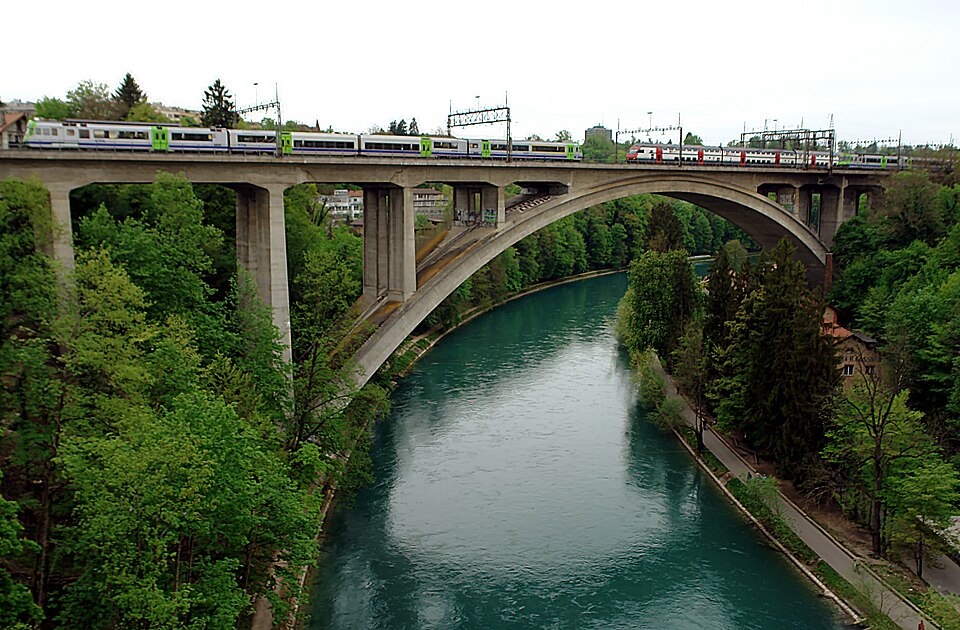
Since 1941 the Lorraine Viaduct has carried trains for 1092 metres from Bern station across the Aare to Wylerfeld, with a 150-metre concrete arch.

- Built
- 1937–1941 (building inventory); 1936–1941 (Wikipedia)
- Architect
- H. Klauser
- Today
- Bern–Olten railway line; listed as worthy of protection
- Client
- Swiss Federal Railways SBB
- Engineer
- A. Bühler
- Length
- 1092 m, arch span 150 m
About the building
Looking downstream from the Lorrainebrücke road bridge, you see a wide concrete arch leaping across the Aare right next to it. It belongs to the Lorraine Viaduct, which carries trains between Bern station and Wylerfeld towards Olten. The railway officially calls the structure simply "Lorraine". At 1092 metres it was the longest railway bridge in Switzerland when it opened in 1941; only in 1969 was it overtaken by the Hardturm Viaduct, 1126 metres long.
The reason for building it was the Rote Brücke of 1858, the old railway bridge at this spot. With ever heavier trains and denser traffic it became a bottleneck, and in the end two trains were no longer allowed on it at the same time. From 1918 the Swiss Federal Railways (SBB) had various options studied, and in 1929 it was decided to move the line from the route of today's Nordring to the Lorraine slope and rebuild it with four tracks. According to the City of Bern's building inventory it was built from 1937 to 1941; the German Wikipedia gives 1936 as the start. The inventory names A. Bühler as engineer and H. Klauser as architect.
The viaduct consists of four bridges in a row, mostly of reinforced concrete: the 400-metre section across the Talweg hollow, 199 metres on the Lorraine plateau with a mushroom slab, the 327-metre Aare bridge and 199 metres over the Schützenmatte and Neubrückstrasse. Its centrepiece is the arch over the river, with a span of 150 metres and a rise of 33 metres. It is built as a hollow box and becomes slimmer towards the crown. It was cast on timber falsework made of twelve truss frames that spanned 146 metres without support.
On 12 June 1941 twenty steam locomotives were placed on the new bridge for the load test. Today the viaduct belongs to the SBB, and the city's heritage office lists it as worthy of protection. It praises the clear design: the spacing of the supports that carry the deck above the arch also decreases towards the middle. A detail to look for from the riverbank: the upper edge of the arch projects slightly and casts a shadow that takes away some of the massive arch's heaviness.
Researched and summarised by Bärn Kit. Sources: Bauinventar der Stadt Bern: Eisenbahnbrücke (Länggasse-Neufeld) · Wikipedia (de): Lorraineviadukt · Wikipedia (en): Lorraine railway viaduct · Wikipedia (fr): Viaduc de Lorraine · Wikidata: Q1870402
Buildings nearby
Blutturm220 mBern Vocational School240 mKunstmuseum Bern340 mHaus der Kantone (House of the Cantons)360 mFormer Bollwerk post office390 mUntitledArtwork · 130 mArmchair, Bed, CarpetArtwork · 140 mUntitledArtwork · 150 mMore sights in Bern
Nydeggbrücke (Nydegg Bridge)Bridges and viewsUntertorbrückeBridges and viewsKirchenfeld BridgeBridges and viewsKornhaus BridgeBridges and viewsAltenbergstegBridges and viewsClassification and address: Bauinventar © Amt für Kultur des Kantons Bern · Wikidata. Found a mistake? Write to hallo@uebrig.ch.