Untertorbrücke
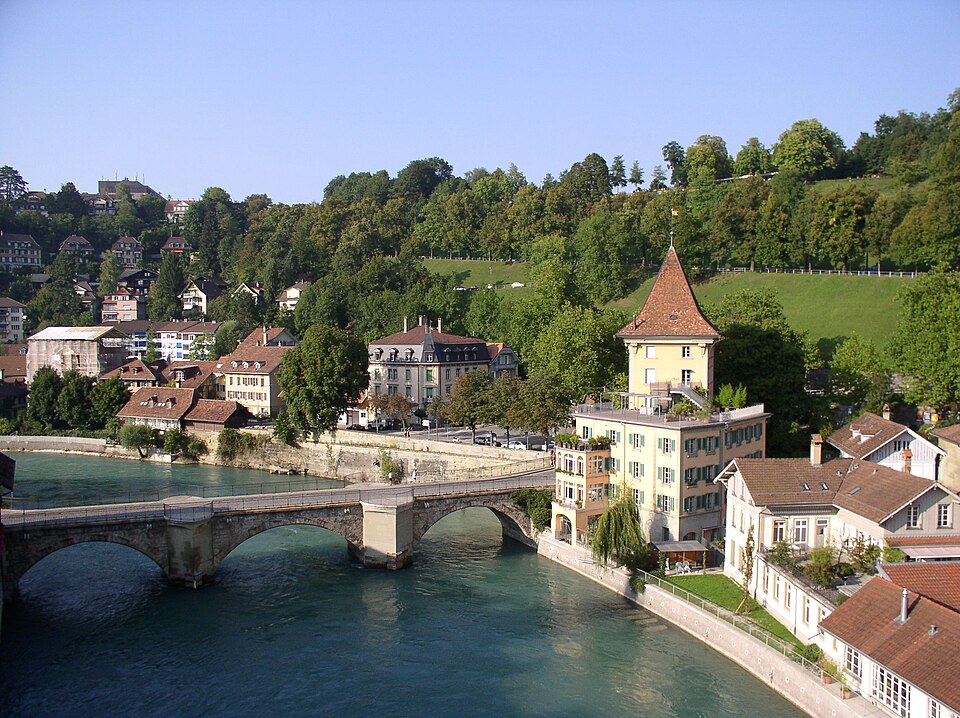
The Untertorbrücke at the eastern end of Bern's Old City is the oldest bridge across the Aare in Bern; the stone arch bridge was begun in 1461/62.

- Address
- Untertorbrücke
- Built
- 1461/62–1487 or 1489 (wooden bridge from 1255/56)
- Architect
- Unknown; the master builder of the Limmat bridge in Baden
- Style
- Late medieval stone arch bridge
- Today
- Road bridge for vehicles and pedestrians
- Protection
- worthy of protection (Bauinventar)
About the building
At the eastern end of the Old City, below the Nydegg, the Untertorbrücke crosses the Aare on three arches. Until the 19th century it was Bern's only bridge over the river. On the right bank stands the Untertor tower, now called the Felsenburg; the road bends to the south at the point where it used to run beneath the tower.
Soon after the city was founded, Bern needed a way across the Aare. A first bridge of wood was finished in 1255 or 1256; sources give both years. In 1460 a flood damaged it badly. As early as 1461 or 1462 work began on a stone bridge, and the master builder who had built the Limmat bridge in Baden was brought in. By about 1467 the piers were standing; after that, work stalled because of high costs and wars. The bridge with its gates and fortifications was complete in 1487 according to German Wikipedia, in 1489 according to the building inventory and English Wikipedia.
In the 18th century the defences had lost their military value and were getting in the way of traffic. The whole fortress-like superstructure was taken down, a simple sandstone parapet was added and Baroque gates were built at both ends. From 1818 an iron railing replaced the parapet and the inner gate disappeared. The outer gate was demolished in 1862 according to the building inventory, in 1864 according to English Wikipedia. Since then the bridge's appearance has hardly changed. When the Nydeggbrücke opened in 1844, traffic over the Untertorbrücke fell sharply.
What you see today is essentially the 15th-century structure without any of the later additions. The sturdy piers stand on sandstone humps in the riverbed; on the outside they are made of limestone and sandstone blocks, inside of sandstone rubble set in mortar. At the top, their triangular cutwaters end in granite cover slabs shaped like fish heads. Only the arches also date from the construction period in their material; they are mostly of tuff. The bridge was repaired in 1979–1981, and the roadway and footpaths were newly paved. On 18 May 2025 the city's voters approved a credit for a further full renovation with more than 91 per cent in favour.
One detail: the granite cover slabs in the shape of fish heads on top of the piers.
Researched and summarised by Bärn Kit. Sources: Bauinventar der Stadt Bern: Untertorbrücke · Wikipedia (de): Untertorbrücke · Wikipedia (en): Untertorbrücke · Wikidata: Q665373

Buildings nearby
Untertor Tower (Felsenburg)40 mLändtetor50 mStöckli of the former Klösterli inn70 mVon Werdt Memorial at Klösterlistutz90 mStöckli of the former Klösterli inn (Klösterlistutz 18A)90 mTown sceneArtwork · 40 mMessenger Fountain (Läuferbrunnen)Artwork · 60 mScenes from the New TestamentArtwork · 110 mMore sights in Bern
Nydeggbrücke (Nydegg Bridge)Bridges and viewsKirchenfeld BridgeBridges and viewsKornhaus BridgeBridges and viewsLorraine ViaductBridges and viewsAltenbergstegBridges and viewsClassification and address: Bauinventar © Amt für Kultur des Kantons Bern · Object sheet (PDF, German) · Wikidata. Found a mistake? Write to hallo@uebrig.ch.