Kirchenfeld Bridge
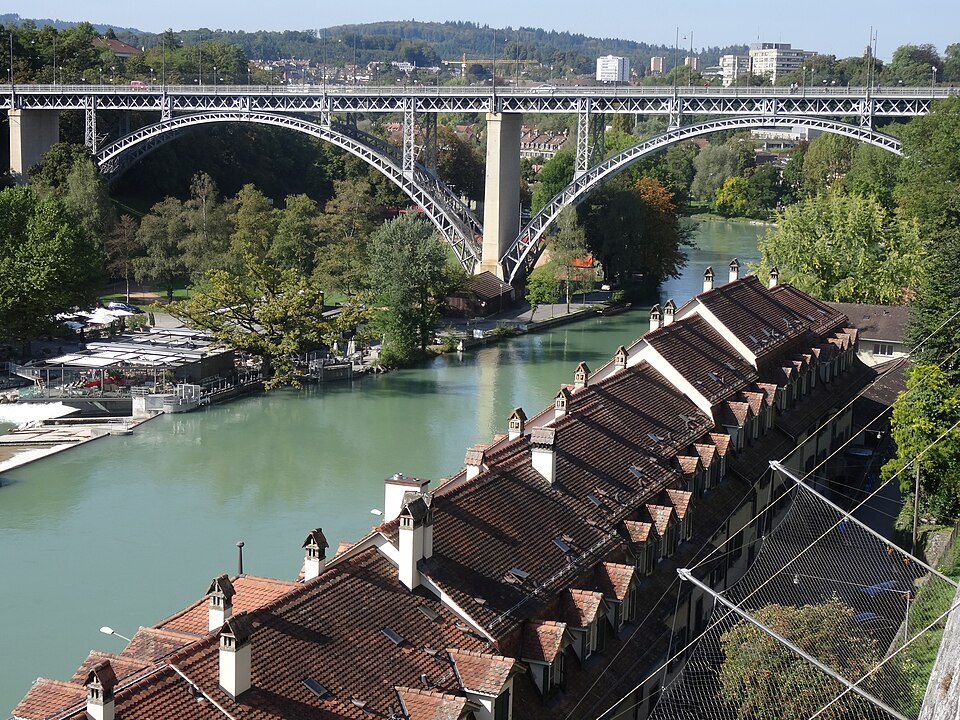
Since 1883 the Kirchenfeld Bridge has linked Casinoplatz with the Kirchenfeld; the iron arch bridge opened up the new residential district.

- Address
- Kirchenfeldbrücke
- Built
- 1881–1883
- Architect
- Engineers Moritz Probst and Jules Röthlisberger (G. Ott & Cie.)
- Style
- Riveted twin-arch bridge of wrought iron
- Today
- Road and tram link between the old town and the Kirchenfeld
- Protection
- cultural property of national significance (KGS A), worthy of protection (Bauinventar)
About the building
From Casinoplatz the Kirchenfeld Bridge crosses the Aare to Helvetiaplatz. Looking up from below, for example from Aarestrasse, you see two shallow arches of riveted lattice girders on which iron truss piers carry the straight deck. The bridge is about 230 metres long; for the span of each of the two arches the Bauinventar gives 81 metres, the city and Wikipedia 78 metres.
Ideas for a bridge to the Kirchenfeld existed as early as the early 19th century. It was only built after the Berne Land Company was founded in London in 1881. The company bought the Kirchenfeld for 425,000 francs to develop it as a residential district and in return built the bridge. An inexpensive project by the Bernese ironworks Gottlieb Ott & Cie. was chosen; it was designed by the engineers Moritz Probst and Jules Röthlisberger. Work began on 15 December 1881, the arches were assembled from November 1882 to March 1883, and on 24 September 1883 the bridge was opened with a large public festival. Because of its English backers, people long called it the "English Bridge".
Before it, only two bridges of this type had been built in the country, the Schwarzwasser bridge and the Javroz bridge in the canton of Fribourg. The structure consists of about 1,300 tonnes of wrought iron. The Bauinventar counts it among the main works of iron construction in the country. After completion it belonged to the canton, and since 1953 to the city.
Traffic changed the bridge again and again. It received a first tram track in 1901 and a second in 1913/14. Because the bridge had vibrated from the start, the main piers were reinforced at that time: according to Wikipedia they were encased in reinforced concrete, according to the Bauinventar replaced in stone. In 1972 the cast-iron railings gave way to new ones of light metal, and in 2018 the bridge was renovated and strengthened again.
A small piece of the past remains: opposite the Kunsthalle, 55 centimetres of the old railing are still preserved. And anyone who knows Pascal Mercier's novel "Night Train to Lisbon" knows that its story begins on this bridge.
Researched and summarised by Bärn Kit. Sources: Bauinventar der Stadt Bern: Kirchenfeldbrücke · Wikipedia (de): Kirchenfeldbrücke · Stadt Bern: Factsheet Kirchenfeldbrücke · Wikidata: Q1743111
Buildings nearby
Casino Bern160 mSwiss Alpine Museum (building)160 mWattenwylhaus at Herrengasse 23170 mTwo Houses at Feldeggweg 3 and 5190 mChurch of Christ, Scientist on Helvetiaplatz190 mQuo Vadis / ProcessArtwork · 30 mCast-iron railingArtwork · 120 mThe Silent PorterArtwork · 120 mMore sights in Bern
Nydeggbrücke (Nydegg Bridge)Bridges and viewsUntertorbrückeBridges and viewsKornhaus BridgeBridges and viewsLorraine ViaductBridges and viewsAltenbergstegBridges and viewsClassification and address: Bauinventar © Amt für Kultur des Kantons Bern · Object sheet (PDF, German) · Wikidata. Found a mistake? Write to hallo@uebrig.ch.