The gallery with no ticket: art on Bern's cemeteries
At the Zentrum Paul Klee or the Kunstmuseum Bern you pay 20 to 24 francs to get in. On the cemeteries there are sculptures, reliefs and grave monuments by well-known artists, free and open around the clock.

While taking photos for the art map, I kept ending up on cemeteries. The Bremgartenfriedhof, the Schosshaldenfriedhof and the Friedhof Bümpliz hold a surprising number of works of art, from bronze figures to pieces in steel. Often I was almost alone with them. Why do we pay for art in a museum and walk past this art here?
Admission: 0 francs
A regular ticket for the Zentrum Paul Klee costs 20 francs, for the Kunstmuseum Bern 24 francs (as of November 2026). The city's three cemeteries, on the other hand, are open at all times and cost nothing. The city describes the Bremgartenfriedhof, opened in 1865, as a large, old park with fountains and sculptures.
The City of Bern's register "Kunst im öffentlichen Raum" (art in public space) lists almost 60 works on these three cemeteries. We have added 16 more, from our own walks and from OpenStreetMap, Wikidata and Wikimedia Commons, each with a source. The map now shows 74; the full list is below.
Paul Klee, a stone's throw from the museum
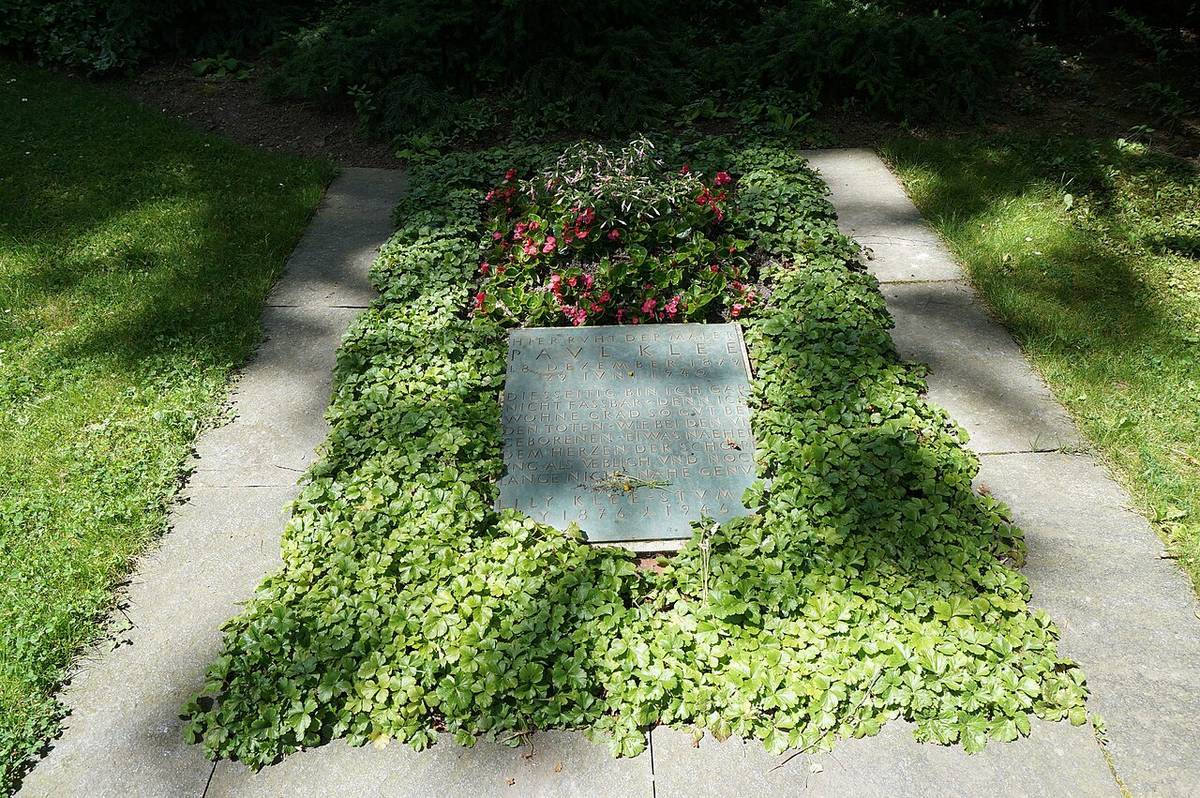
Paul Klee is buried at the Schosshaldenfriedhof. His grave is a plain bronze plate on the ground, which also names his wife Lily Klee-Stumpf. The Zentrum Paul Klee is close by for a reason: its founders Maurice E. and Martha Müller wanted the museum in the quarter where Klee's grave is. It opened in June 2005. A path leads from the museum to the cemetery; the grave is about 230 metres away.
The plate carries a text that, according to the sources, Klee wrote himself as early as 1920:
"Diesseitig bin ich gar nicht fassbar. Denn ich wohne grad so gut bei den Toten wie bei den Ungeborenen. Etwas näher dem Herzen der Schöpfung als üblich. Und noch lange nicht nahe genug." (In this world I cannot be grasped. For I live just as well with the dead as with the unborn. Somewhat closer to the heart of creation than usual. And still not close enough.)
On the same cemetery, Louis Moilliet's sgraffito Musizierende Engel (angels making music) has decorated the chapel since 1939. Moilliet was a friend of Klee's and travelled with him to Tunis in 1914.
Living from art?
Many artists in Switzerland earn little. In a 2021 survey commissioned by Suisseculture Sociale and Pro Helvetia, 60 percent said they lived on less than 40,000 francs net a year; among the self-employed it was 67 percent. On average they worked 45 hours a week.
It is often said that art only becomes valuable after the artist's death. For Vincent van Gogh that is true: he sold hardly anything in his lifetime, and the great recognition only came afterwards. But it is not a rule. Paul Klee was already internationally respected in his lifetime. In 1910 the Kunstmuseum Bern was the first art institution to give him a solo exhibition. Even so, in his early years it was his wife Lily who earned the family's money as a pianist and piano teacher. Economists have observed that prices for some artists rise around the time of their death. That does not help the many whose works are never traded. A start is to look at the art that is already here, and to know the names of the people behind it.
A place to reflect
The city's cemetery regulation calls the cemeteries "places of rest, reflection and recreation". They are not always quiet: at the Schosshaldenfriedhof you can hear the motorway. Still, on a cemetery we think about our own life and our own mortality. At the Bremgartenfriedhof, the city's Besinnungsweg (reflection path) invites you to do that with short texts. Guided walks for groups are free.
Many of the works are about this. Karl Schenk's sculpture Sein und Werden (being and becoming, 1938) at the old entrance of the Bremgartenfriedhof stands for life and death. Schang Hutter's sculptures and reliefs on the Urnennischenwand (urn niche wall) in Bümpliz also carry poems by Peter Bichsel and Friedrich Hölderlin.
What there is to see
At the Bremgartenfriedhof, the grave of the politician Robert Grimm carries a portrait head by Karl Schenk (1933), and the grave of Eugen Huber, author of the Swiss Civil Code, a grave monument by Hermann Hubacher (1929). On the grave of Margrit and Hermann Rupf stands the bronze Femme accroupie by Henri Laurens (1935). At the communal grave there are the blue wall and the blue roller by Christoph Haerle (1996–1997), and at the main entrance the Kenotaph by Walter Kretz (2002).
At the Schosshaldenfriedhof, the Grosser Engel (large angel) by Marcel Perincioli belongs to no grave; it is part of the design of the cemetery. Since 1983, a Museumsgrabfeld (museum grave field) has kept typical grave monuments from all three cemeteries. In Bümpliz, the city showed around 30 works in an exhibition in 2013. Roland Fornaro's Über-setzen has stayed.
Bremgartenfriedhof (38 works)
- Paar, Karl Hänny, c. 1903
- Grabmal Eugen Huber, Hermann Hubacher, 1929
- Porträtkopf von Robert Grimm, Karl Schenk, 1933
- Femme accroupie, Henri Laurens, 1935
- ohne Titel, Max Fueter, 1936
- Sein und Werden, Karl Schenk, 1938
- Frauentorso, Hermann Hubacher, 1943
- Vase, Max Fueter, 1951
- Lebensbaum und Lebensstrom, Carl Bieri, 1954-1956
- Kreuzigung Christi / Grablegung Christi / Auferstehung Christi / Christus mit Engeln, Gustave Piguet, 1955
- Christliche Symbole, Peter Stein; Max von Mühlenen, 1956
- Die vier Tierkreiszeichen der vier Jahres- oder Lebenszeiten, Gustave Piguet, 1956
- ohne Titel, Walter Linck, 1957
- Das vorüberziehende Vergängliche (Engel), Albert Lindegger, 1959
- Das vorüberziehende Vergängliche (Paar), Albert Lindegger, 1959
- Sterbender Jüngling mit Frauenfigur, Karl Schenk, 1959
- Ankerkreuz mit Dornenkrone, Marcel Perincioli, 1964
- Weibliche Figur, Karl Schenk, 1964
- Ehrengrabmal Eduard Freimüller, August Paris, 1966
- Grabmal Charles Hector Gosset, Walter Speich, 1971
- Rodogune, Max Fueter, 1975
- ohne Titel, Marcel Perincioli, 1976
- Lebensbaum, Richard Wyss, 1980
- Grabmal Kurt Schaufelberger, Willy Weber, 1983
- Rede Herr, dein Diener hört, Franco Annoni, 1991
- ohne Titel, Christoph Haerle, 1996-1997
- Der gute Geist, Hedwig Hayoz-Häfeli, 1997
- Grabmal Heinz Jost, Walter Kretz, 1997
- Kenotaph, Walter Kretz, 2002
- Sinnende Frau, Hedwig Hayoz-Häfeli, 2002
- Anatomiegrab, Walter Kretz, 2011
- Adler, Unknown artist
- Adorantin, Walter Schnegg
- Brunnen mit Rundtempel, Unknown artist
- Familiengrab von Theodor Kocher, Unknown artist
- Frauenfigur (Grabmal), Unknown artist
- Grab von Michail Bakunin, Daniel Garbade
- ohne Titel (Edelstahlplastik), Unknown artist
Schosshaldenfriedhof (27 works)
- Altes Eingangsportal des Friedhofs, Unknown artist, c. 1877
- Säulen-Halbrund mit zwei Frauenfiguren, Louis Wethli, 1926
- Kniende, Max Fueter, 1931
- ohne Titel, August Paris, 1934
- Die Auferstehung des Fleisches, Leo Steck, 1936
- Musizierende Engel, Louis Moilliet, 1937-1939
- Porträt von Prof. Dr. iur. F. Volmar, von Arx, 1945
- Sitzender Mann / Athlet?, Marcel Perincioli, 1952
- Grosser Engel, Marcel Perincioli, 1958-1959
- Portrait-Relief des Malers Ernst Kreidolf, Max Fueter, 1958
- Grabmal Joseph Dettling, Unknown artist, 1960
- Paar, Gustave Piguet, 1961
- Mädchen, Gustave Piguet, 1962
- Porträt von Otto Kreis, dirigierend, Gustave Piguet, 1966
- Lebensflamme, August Paris, 1968
- Lebenslauf, Max Fueter, 1970
- Schwebende weibliche Figur, Walter Schnegg, 1971
- Kniender Jüngling, Gustave Piguet, 1972
- Weibliche und männliche Figur, Max Fueter, 1973
- Urnennischenanlage, Mariann Grunder, 1975-1978
- Auferstehung, Marcel Perincioli, 1979
- Sitzende, Bettina Eichin, 1989
- Grab von Paul Klee, Unknown artist
- Museumsgrabfeld, Unknown artist
- Phoenix, Hedwig Hayoz-Häfeli
- ohne Titel, Unknown artist
- ohne Titel, Unknown artist
Friedhof Bümpliz (9 works)
- ohne Titel, Gian Fontana, 1972
- Gemeinschaftsgrab, Walter Kretz, 1975
- Kauernde Frauenfigur, Walter Schnegg, 1975
- Urnennischenwand, Schang Hutter, 1994
- Grab Thea Ketterer, Frantiček Klossner, 2001
- Reflexionen, Hubert Dechant, 2004
- Windfahne, Monika Gallegra; Joseph Fässler; Martha und Walter Hofer, 2013
- Über-setzen, Roland Fornaro, 2013
- ohne Titel, Unknown artist
Taking photos with respect
In Switzerland you may photograph works of art that stand permanently outdoors on generally accessible ground and publish the pictures (Copyright Act, Art. 27). Three-dimensional copies are not allowed. On the cemetery, the regulation applies as well: disturbing the peace and inappropriate behaviour are forbidden. So do not photograph mourners or funeral services, and be discreet with the names on the graves of private persons.
A work is missing from the map, or you have a better photo? Every work page has "Add a photo", and the map has "Suggest a place". Every suggestion is checked by hand.
Also worth reading
The street is our galleryArtAll artworks in Bern from A to ZArtArt in Bern: the mapMapSources
- bern.ch: friedhofe
- bern.ch: bremgartenfriedhof
- bern.ch: schosshaldenfriedhof
- bern.ch: friedhof buempliz
- bern.ch: shf brosch.pdf
- bern.ch: broschure bremgartenfriedhof 2023.pdf
- bern.ch: broschure friedhof buempliz 2018.pdf
- bern.ch: persoenlichkeiten prominenz.pdf
- bern.ch: besinnungsweg
- stadtrat.bern.ch: 3596ef71dedd499aad75900d8eac8ada 332 (Friedhofreglement, Art. 3)
- zpk.org: gruendung
- zpk.org: paul klee biografie
- zpk.org: tickets
- kunstmuseumbern.ch: tickets
- aboutswitzerland.eda.admin.ch: paul klees universe of images and his work in bern
- fedlex.admin.ch: 1798 1798 1798 (URG Art. 27, 29, 32)
- suisseculturesociale.ch: Absicherung Kulturschaffende Bericht Schlussbericht 210624 de.pdf
- vangoghmuseum.nl: after vincents death
- ideas.repec.org: v24y2000i4p283 300.html
- Kultur Stadt Bern, Kunstwerke im öffentlichen Raum (offene Daten)
- OpenStreetMap, Wikidata, Wikimedia Commons
Data: Kultur Stadt Bern (open data “Kunst im öffentlichen Raum”), © OpenStreetMap contributors. Text: Richard Červenka, Bärn Kit. Found a mistake? Write to hallo@uebrig.ch.